





Abandoning the notion of a static, spiritual Orient to plunge into a dazzling torrent of pop, colours and rhythmic layers. This is the endeavour undertaken by Eun-Me Ahn with Post-Orientalist Express, which had its national premiere at the Teatro Argentina as part of the Romaeuropa Festival 2026. On stage, there is no room for museum-like contemplation or folkloric postcard imagery; dance immediately becomes an open field of action, a hyperkinetic device that takes old colonial stereotypes and forces them to derail, transforming them into a brazen and unpredictable visual spectacle.

From its very title, the work evokes a symbol of transit and modernity – such as the train, the borderline, the journey between the observing West and the observed Elsewhere – only to radically subvert it through a veritable derailment of meanings. The dramaturgy, refined in collaboration with Geun-Jun Changwoo-Michael Lim, takes its cue from Edward Said’s famous deconstruction of Orientalism, reorienting it towards a post-Orientalist perspective that erases fixed geographical coordinates. Crossing the threshold of this journey meant abandoning any position of comfortable, detached distance to allow oneself to be sucked into a hyperkinetic ecosystem, a circuit in which the choreography functions as an unstable force field, ready to derail at every turn. The nine performers on stage, led by Ahn herself, shun any temptation towards folkloric mimesis or museum-like sacredness.

Rather than replicating a rigid, ‘postcard-perfect’ tradition, the company dismantles it from within, where the choreographic and sound materials gathered from various Asian regions – ranging from the chaotic flows of contemporary metropolises to the remnants of ancient ritual practices – are treated as living samples, stray fragments of an archive in perpetual short-circuit that reassembles itself on stage into brazen and irreverent forms.
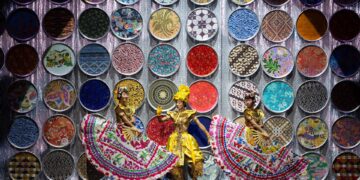
On stage, the bodies obey no academic or codified rules, but become a malleable and porous substance, traversed by opposing tensions that carry with them the echo of a unique journey – one that unites rigorous Korean roots, the freedoms of the New York avant-garde and the historic partnership with Pina Bausch. Under Jinyoung Jang’s strobe lighting, which dissects the space and distorts the perception of time, the costumes designed by the choreographer herself in collaboration with Yunkwan Design explode into a visual overload of optical patterns, fluorescent geometries and androgynous ambiguity. There is nothing purely decorative about this chromatic orgy; kitsch and visual exaggeration act as genuine political devices.

Faced with a West that continues to project onto the East the idea of an unchanging, spiritual and unspoilt essence, Ahn responds by continually derailing from the tracks of the familiar, multiplying the artistic devices and displaying a feigned exoticism so brazen as to immediately unmask the constructed nature of every cultural identity.
This material and visual density finds its counterpoint in the sound architecture composed and curated by Young-Gyu Jang and in the media interventions curated by Taeseok Lee. The voice and sounds do not merely accompany the action, but traverse it, fragmenting into digital basslines and traditional percussion, transforming into an autonomous substance, an acoustic organism that connects distant spaces. Technology is never a neutral surface or a passive backdrop, but a living medium that breathes alongside the performers, constantly altering the viewer’s perspective. The shamanic ritual, a profound matrix that runs through Ahn’s entire poetics, re-emerges not as a relic of the past, but as an immaterial technology of connection and metamorphosis between incompatible worlds.

Suspended between memory and visual short-circuit, *Post-Orientalist Express* stands out as a celebration of excess. By choosing the path of fierce irony and poetic accumulation, Eun-Me Ahn’s work reminds us that the contemporary scene is the place where categories of identity can derail, free themselves from their historical cages and become a pure, pulsating choreography of the future.
Lidia De Nuzzo, Carlotta Zambelli
Eun-Me Ahn, Post-Orientalist Express, Romaeuropa Festival 2026 (Ultra Club), 24–15 September 2026
images: (all) Eun-Me Ahn, Post-Orientalist Express, Romaeuropa Festival 2026 (Ultra Club), photo: Cosimo Trimboli