


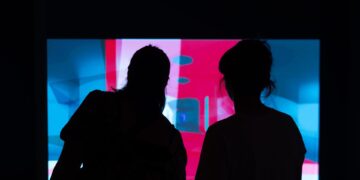
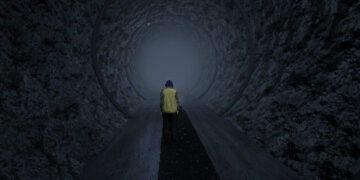


Palazzo Diedo in Venice, a recent acquisition by Berggruen Arts & Culture, provides an exquisite 18th-century setting, adorned with white stucco, for avant-garde research, with a focus on the intersection between the humanities and the sciences.
Following a swift yet meticulous restoration carried out by the Silvio Fassi studio, the Palazzo has hosted Janus (2024) and The Next Earth: Computation, Crisis, Cosmology (2025). This year, to coincide with the Art Biennale, it has opened two new exhibitions: Strange Rules, co-curated by Mat Dryhurst, Holly Herndon and Hans Ulrich Obrist, explores new artistic research by introducing the concept of Protocol Art, whilst another exhibition, Unfinished, curated by Ann Gallagher and Jonathan Watkins, presents the works of the British artist Ceal Floyer, who recently passed away.
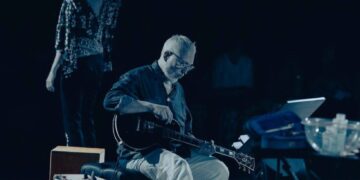
The two exhibitions intertwine along an ascending exhibition route, beginning on the ground floor, where a typical Venetian portego — a central hall flanked by smaller rooms separated by arches — accommodates the first group of works embodying the exhibition’s central themes. At its heart, a collaboration between the Berlin-based architecture studio SUB and artists Mat Dryhurst and Holly Herndon takes shape as an active listening environment, where our perception is altered by our very presence in the space. The work Attention Guild imagines new forms of collaboration between human beings and computational systems. A group of software agents work together towards a shared goal, producing sonic results that visitors can listen to throughout the exhibition from a purpose-built, linear agora. The melody will never be the same twice.
 Invisible communication thus characterises some of the works in this exhibition conceived as an ongoing laboratory. The key concept of the intangible processing of data had already been introduced to Venice through Pierre Huyghe’s exhibition Liminal (Pinault Collection, Punta della Dogana, 2024), where hidden sensors connected to equally invisible algorithms shaped the experience of unsuspecting visitors.
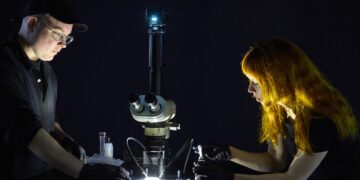
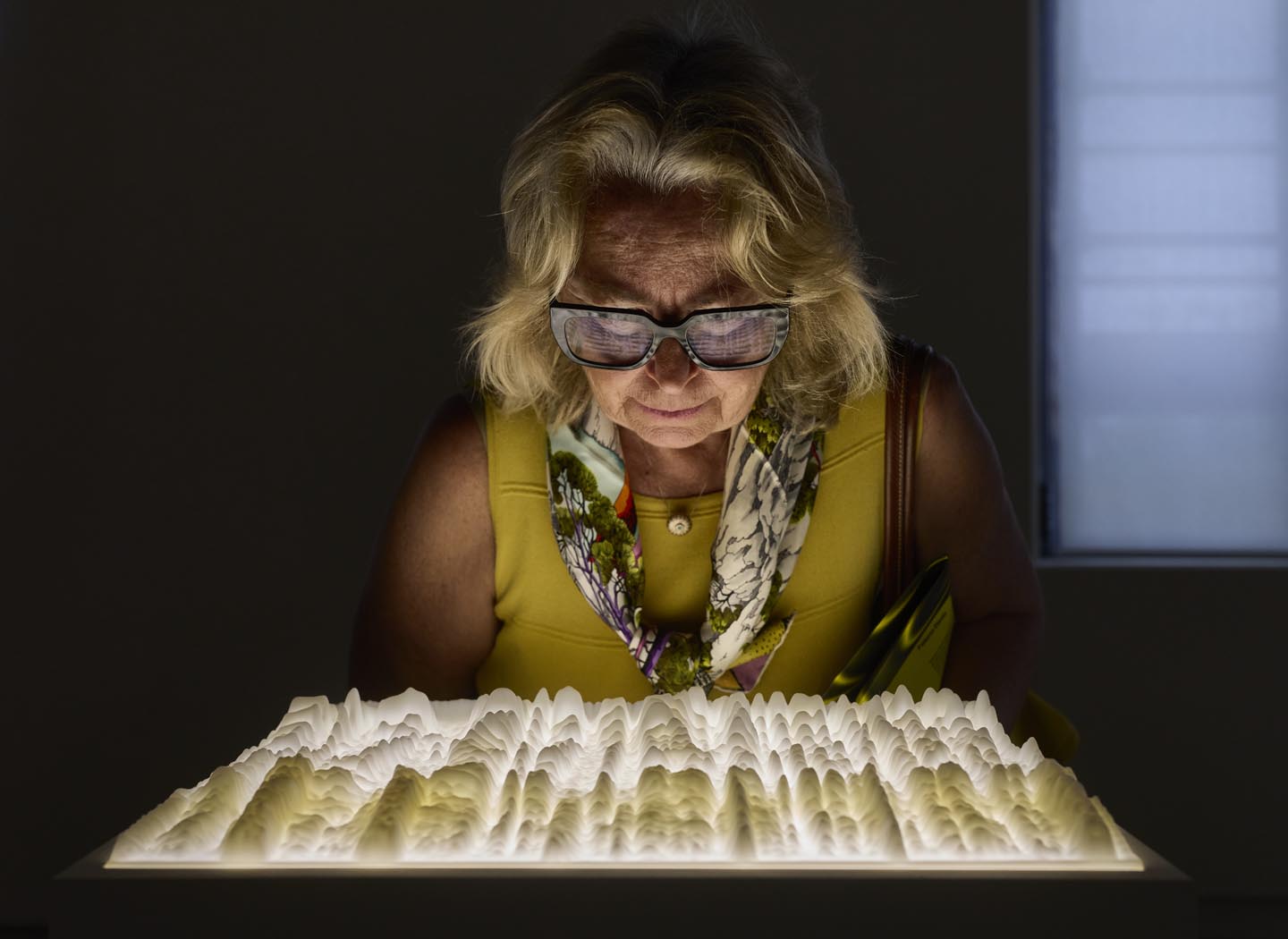
Once again, the exhibition’s title offers a clue: Strange Rules. Following this logic, while remaining closely connected to the notion of invisibility, the curators have included a section dedicated to scientific research. Here, biologist Michael Levin presents his investigations into bioelectricity applied to the cells of a worm (Double-Headed Planaria, ongoing research), without requiring any interaction from the viewer. At the centre of the room stands a microscope, the quintessential instrument for making the invisible visible, accompanied by projections of these curious two-headed worms. The work itself raises questions about whether it belongs in an art exhibition, although no complaints have been received so far.
The final room on this floor transports us into what might be the bedroom of a teenager immersed in post-internet culture: a Wunderkammer scattered with polyester T-shirts, dropshipped baseball caps, niche theoretical texts ranging from sociology to conspiracy theories, and countless cans of energy drinks. It offers a tangible image of how the mainstream internet has fragmented into a myriad of closed niches, abandoning the large shared public spaces of the past. In an installation designed by SUB, Online Marketplace of Ideas (Joshua Citarella and New Models, 2026) brings the objects produced by these digital enclaves into physical space. Particularly prominent is creator merchandise, which transforms fabric into an analogue technology of consensus, communicating where screens cannot reach. Wearing these garments becomes a declaration of collective allegiance, while seeing this assortment of objects together makes the cultural and political incoherence of our present both tangible and visually compelling.
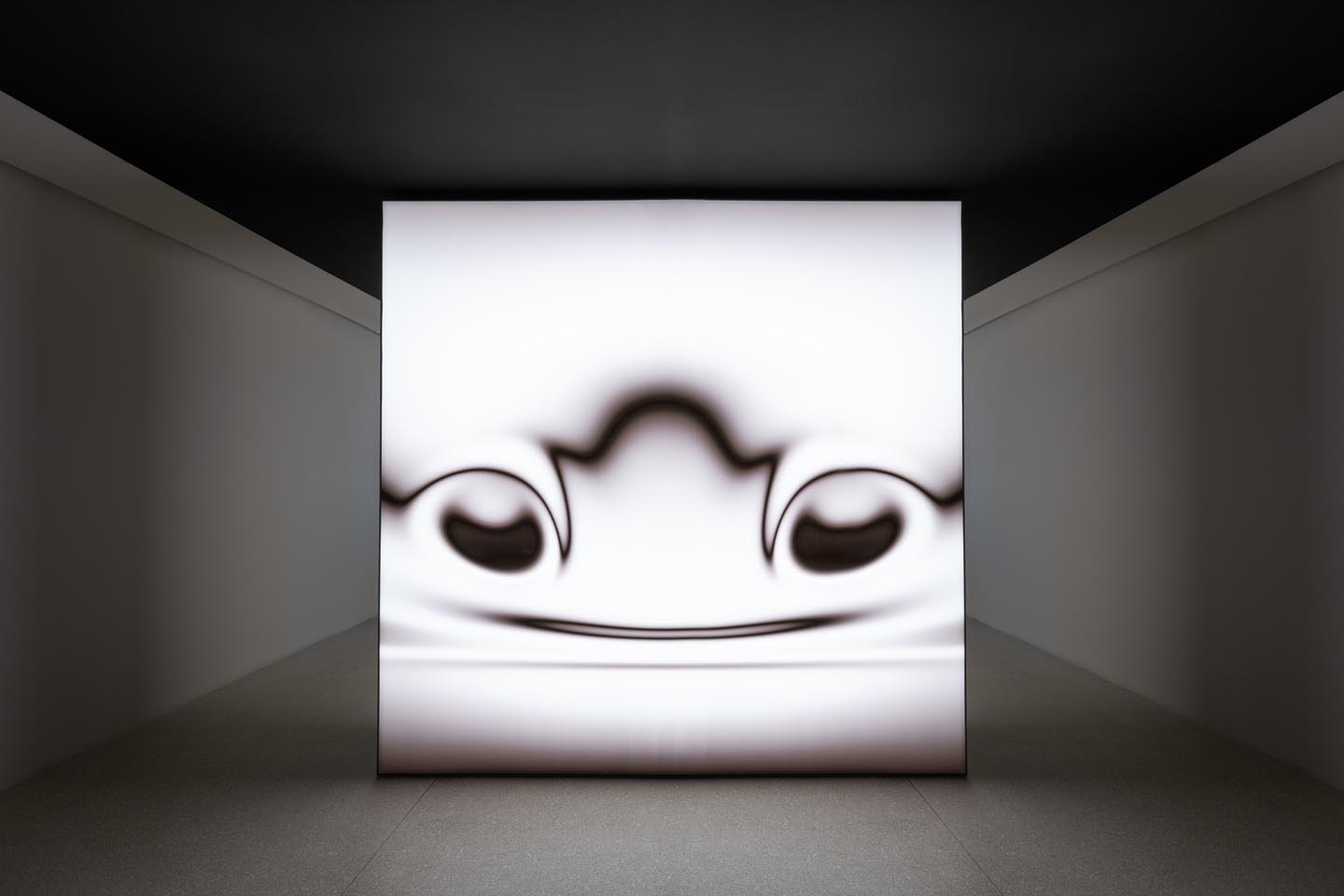
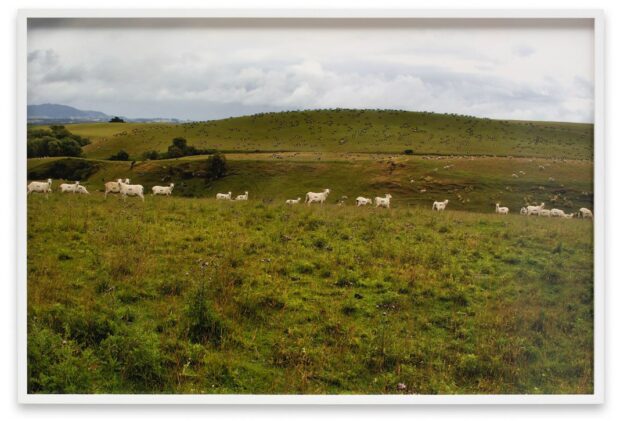
On the mezzanine floor, the exhibition route is interrupted by a commemorative solo presentation dedicated to the recently deceased British visual artist Ceal Floyer. Small yet remarkably dense, the exhibition is titled Unfinished. The title cleverly reveals the essence of the artist’s practice: minimal works dominated by white and, at first glance, a sense of incompleteness. Her media range from video and sound to photography and readymades, all permeated by a subtle yet merciless humour rooted in everyday life.
The exhibition takes its title from a video work first presented in Venice during the 1995 Biennale. A silent loop, projected using a now outdated DVD player, welcomes us into what seems to be a space devoted to waiting, showing the familiar gesture of twiddling one’s thumbs — a habit that has become almost obsolete now that mobile phones are constantly in our hands.
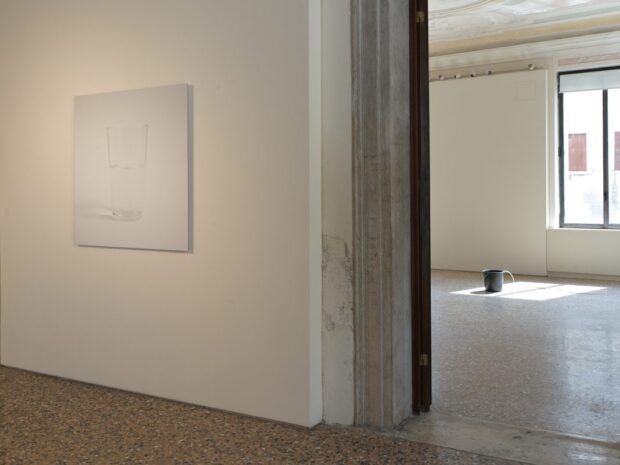
A little further on, displayed in two separate rooms, we encounter the two components of Half Empty / Half Full (1999), which confront us with a dilemma as simple as it is disconcerting: which of the two glasses — identical, it should be noted — is half full, and which is half empty? Even more radical is Bucket (1999), where the auditory illusion of a drop of water falling into a plastic bucket is immediately disrupted by the thick white cable emerging from it, revealing the loudspeaker inside that produces the sound. It is a conceptual short circuit, as minimal as it is irreverent.
These rooms, like the rest of the palazzo, are framed by site-specific works. In this case, artists Ibrahim Mahama and Jim Shaw have decorated the stucco ceilings, following the original style of the interiors.
On the first floor, we are greeted by Primavera De Filippi’s Plantoids, archetypal examples of Protocol Art: hybrid life forms combining digital and mechanical elements that humans can “feed” by sending cryptocurrency. Once sufficient funds have been collected, the work generates new seeds in the form of NFTs, and its DAO (Decentralized Autonomous Organization) launches an open call to create the next specimen. Seed holders then vote on the submitted proposals, and the Plantoid autonomously transfers the funds to the winning artist to produce a new iteration of itself. It is a generative process that exists in close interaction with its audience.
In another room on the same floor, the focus on “painting” emerges from a dense network of collaborations, influences, archival research, and exhibition strategies, all coexisting within the present condition described by Venkatesh Rao as the Gramsci Gap, from which the installation takes its title. This is a transitional phase in which the old world is dissolving while the new struggles to emerge. Within this limbo, new “monsters” take shape, identifiable here as artificial intelligence, cryptocurrencies, and digital platforms.
Engaging directly with Rao’s theories, artist Simon Denny has created a series of panels in which machine-assisted painting, AI protocols, references to Futurism and the aesthetics of military technology, and experimental printing techniques converge on surfaces that, at first glance, could easily be mistaken for works by an Italian Informalist painter. The display system, explicitly inspired by Franco Albini’s installation for Scipione’s 1941 exhibition at the Accademia di Brera, institutionalises these chaotic experiments, presenting us with questionable works of art mounted in traditional floater frames. In the background stands a monumental canvas by Harold Cohen, a true pioneer of the relationship between painting and artificial intelligence, serving both as a warning and as a historical counterpoint.
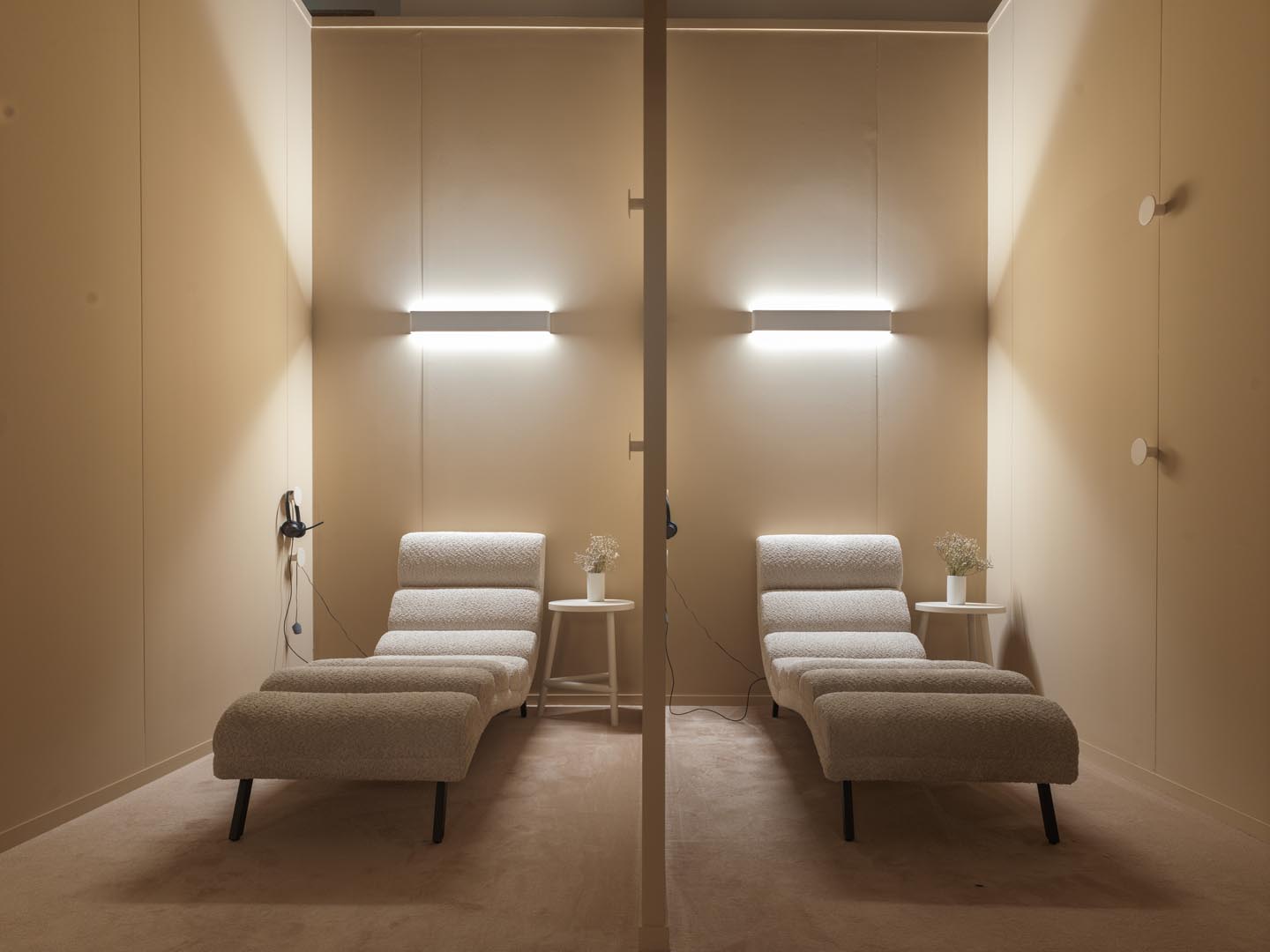
In a setting resembling a luxury clinic, with its muted beige tones, we encounter Trevor Paglen’s new interactive audio experiment, Voyager. Visitors are invited to embark on a hypnotic journey while reclining on a comfortable lounger. They must attach heart-rate sensors and choose from a menu of guided audio experiences. Then, wearing headphones and an eye mask, they are led by a voice inexorably towards deep sleep. Even before entering the elegant room, a series of metaphysical-style collages anticipates the visions of the hypersensory journeys awaiting us: a dreamlike prelude that transforms relaxation into a subtle apparatus of observation.
A work that is more than merely functional is the new spiral staircase designed by Carsten Höller to provide visitors with quicker access to the second floor while preserving the palazzo’s eighteenth-century character. Its title, Scala del dubbio (Staircase of Doubt), which sits uneasily with the Palladian rigour of the architecture, is certainly consistent with the artist’s ironic and illusionistic approach to the viewer.
On the second floor, two permanent works engage in very different ways with the city that hosts them. On one side is Urs Fischer’s Omen (2024), a hypnotic suspended installation composed of hundreds of blown-glass droplets descending from the ceiling like rain crystallised in mid-air. It is a direct tribute to Murano’s centuries-old glassmaking tradition, capturing and refracting the lagoon’s ever-changing light.
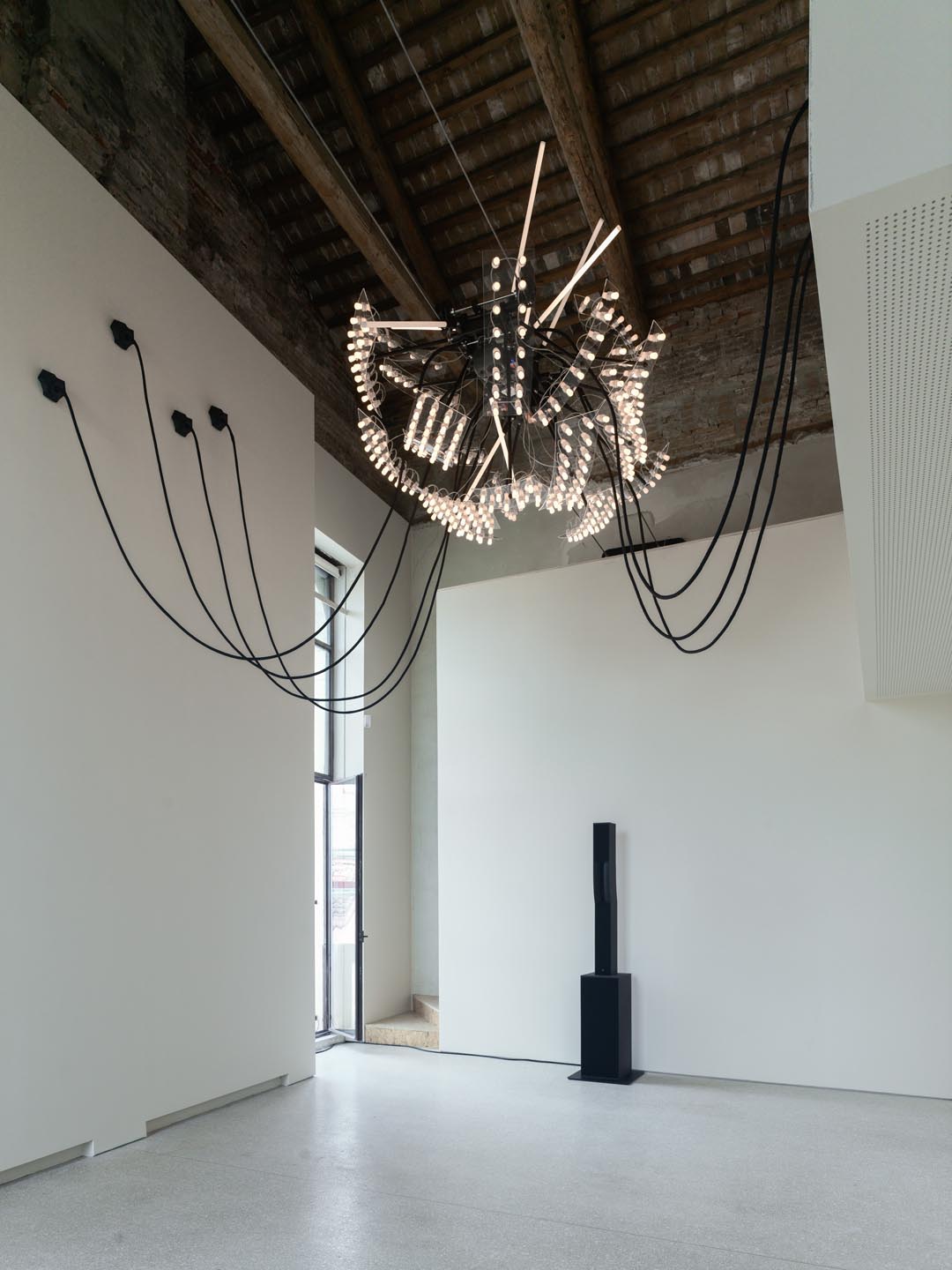
On the other, Philippe Parreno’s The Deambulist Humself (2026) operates as an atmospheric apparatus that absorbs the rhythms of the outside world. Through an invisible score of lights, sounds, and mechanical movements, the installation seems to breathe in unison with the palazzo and everything surrounding it, transforming the room into a sensitive organism that responds to the passing hours and the movement of visitors. These are two interventions at opposite ends of the spectrum: one rooted in the artisanal tradition of glassmaking and the materiality of liquid forms, the other immaterial and algorithmic.
The exhibition route culminates in Palazzo Diedo’s Black Box, an immersive space where painting and digital media merge from the very threshold. Visitors are welcomed by a site-specific fresco by Urs Fischer, an intervention that anchors the room in Venice’s tradition of wall painting. Executed in a single brushstroke, the fresco precedes our descent into the darkness of the projection space.
Here, a programme of video works investigates, from different perspectives, the latent protocols underpinning contemporary society and our relationship with technology.
The programme opens with Fabien Giraud’s The Feral, a collective film entirely directed and edited by artificial intelligence, conceived to unfold over a thousand years, from 2024 to 3024. Over thirty-two generations, human participants and invited artists will contribute to an experiment in “rewilding” on a landscape scale.
The themes of control and invisible forces return in a new entry in Ho Tzu Nyen’s Critical Dictionary of Southeast Asia: thirty chapters edited in real time through AI, based on a dialogue between the artist and a chatbot about the Spinozist concept of Power, understood not as domination but as the capacity for persistence and connection.
Delving even deeper into the mechanisms of consciousness, Agnieszka Kurant presents two complementary works. The first is the holographic short film Wordoid (2025), developed in collaboration with MIT neuroscientist Adam Horowitz, Antoine Bellemare, and Philipp Thölke. Using neurotechnologies and hyperscanning, the work translates a form of pre-verbal digital telepathy between synchronised minds into three-dimensional forms.
The programme concludes with Phantomatics (2026), also by Kurant, created in collaboration with computational linguist Gašper Beguš of UC Berkeley, California. Here, an artificial intelligence generates synthetic languages with their own grammar and chromatic identity, evoking an unsettling future in which autonomous languages evolve entirely without human speakers.
Emerging from these halls, one is left with the sensation of having travelled through an ecosystem of profoundly heterogeneous works, almost impossible to grasp in their diversity of languages and media. It is a multiplicity that still resists definitive systematisation. It is no coincidence that the catalogue of Protocol Art remains a work in progress, an evolving archive that refuses to be confined within the pages of a single volume, precisely because its own codes are changing before our eyes.
Perhaps its ultimate meaning lies in accepting this sense of vertigo without searching for unequivocal answers, allowing ourselves instead to be guided by its strange rules.
STRANGE RULES, curated by Mat Dryhurst, Holly Herndon e Hans Ulrich Obrist with Adriana Rispoli, Palazzo Diedo, Venice (Venice Biennale 2025’s collateral event), 04.05 – 22.11.2026
Artists: Joshua Citarella, Harold Cohen, Primavera De Filippi, Simon Denny with Venkatesh Rao, Stephanie Dinkins, Fabien Giraud, Lawrence Abu Hamdan, He Zike, Holly Herndon & Mat Dryhurst, Lynn Hershman Leeson, Ho Tzu Nyen, New Models, Ayoung Kim, Agnieszka Kurant, Michael Levin, Trevor Paglen, Philippe Parreno, Lorenzo Senni, Avery Singer, Ken Stanley, sub, terra0.
Unfinished. Ceal Floyer, curated by Ann Gallagher e Jonathan Watkins, Palazzo Diedo – Berggruen Arts & Culture, Venezia, 04.05-22.11.2026
images: (cover 1) Mat Dryhurst & Holly Herndon with Double-Headed Planaria by Michael Levin, Installation View of Strange Rules, Palazzo Diedo Berggruen Arts & Culture, foto: David Levene (2) Ceal Floyer, 644 (2025) Inkjet print on museum board, 45 x 67 cm (unframed) Courtesy the artist, Lisson Gallery, 303 Gallery and Esther Schipper Photo © Ceal Floyer © Ceal Floyer / VG Bild – Kunst, Bonn 2026 (3) Fabien Giraud, The Final Epoch 1 (2025 – 2026) Installation View of Strange Rules, Palazzo Diedo Berggruen Arts & Culture, foto: David Levene (3) Ken Stanley, Picbreeder (2008 – 2020). Installation View of Strange Rules, Palazzo Diedo Berggruen Arts & Culture, foto: Stefano Matteo (4) Lawrence Abu Hamdan Waterfalls (2026). Installation View of Strange Rules, Palazzo Diedo Berggruen Arts & Culture, foto: David Levene (5) Ceal Floyer, Unfinished, installation view at Palazzo Diedo Berggruen Arts & Culture, 2026. Photo credit Joan Porcal (6) Trevor Paglen, Voyager (2026) Installation View of Strange Rules, Palazzo Diedo Berggruen Arts & Culture, foto: Joan Porcel (7) Philippe Parreno, The Diambulist Humself (2026), panoramica di installazione di Strange Rules, Palazzo Diedo Berggruen Arts & Culture, foto: Joan Porcel