







The Romaeuropa Festival 2025 is home to some of the most powerful offerings, with Flammenwerfer being a prime example. This show is the result of a unique collaboration between the Danish company Hotel Pro Forma, Blixa Bargeld and the female vocal ensemble IKI. This is a hybrid, experimental and above all multimedia “music theatre” that does not merely interweave languages, but pushes them to collide, dissolve and recompose themselves into a hybrid form where sound becomes vision and vision becomes acoustic matter.
At the heart of the work is the figure of Swedish painter Carl Fredrik Hill (1849-1911), a visionary artist marked by schizophrenia, who, during his years of forced retirement due to his social and relational discomfort, produced hundreds of sketches and drawings, maps of an inner world poised between genius and delirium. The show does not recount his biography in a linear fashion, but evokes it through his multiple and layered works, perceptual states, sensory crossings and imbalances that directly involve the audience.

Blixa Bargeld, who wrote part of the music and lyrics, brings his voice to the stage as extreme performative material: from whispered inflections to screams, his register and his changing presence become a sound body that acts more than the physical body. “There is a song composed solely of screams,” he said in an interview with Lucrezia Ercolani, “a cruel piece that shakes the bones of the ear” (Blixa Bargeld: I am a poet, don’t call me a prophet, ‘Il Manifesto’, 26.09.2025). These are sometimes disturbing, sometimes disorienting incursions onto the stage that tear apart the boundaries of perception and emotional identification.
It is in this suspension between word and noise that the female choir of IKI comes in, capable of constructing layered vocal landscapes, from choral singing to fragmentation, from suspended harmonies to dissonances. Their presence multiplies the voice, disperses it and recomposes it, restoring the sensation of a mind traversed by echoes and multiple presences.

The sound they generate cradles us in a bed of heart-rending words, which convey the rupture between representation, form and content. These are fully human voices, fully capable of creating emotional and reflective scenes.
Alongside Bargeld’s musical compositions, the show features pieces by Nils Frahm, selected for their atmospheric quality, suspended between piano, electronics and drones.
His music intertwines with lyrics and voices in a score that favours repetition, hypnotic tension and sudden leaps in intensity. Once again, the result is a soundscape that does not accompany the action on stage, but determines it: there is no acting in the classical sense, because here the music is the dramaturgy, and the dramaturgy is the total music.
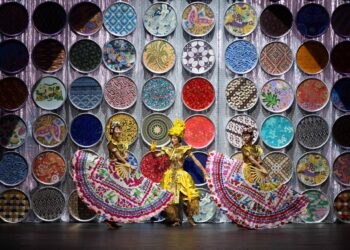
The visual aspect, entrusted to Magnus Pind for the video, Henrik Vibskov for the costumes and Jesper Kongshaug for the lighting, transforms the stage into a field of interference. Projections of Hill’s drawings invade the space and bodies, the costumes become luminous, living, reflective and swollen surfaces, each with its own intimate, private and parallel story.

Light creates appearances and disappearances like an entity that shapes matter and rewrites the dimensions of spaces and bodies. In this device, the stage is not a backdrop: it is a living, unstable screen in which image, vision and signs merge and shape each other. The strength of Flammenwerfer lies precisely in the way in which audio and multimedia do not remain parallel languages but intertwine to the point of losing their boundaries. Sometimes sound and image proceed in unison, many other times they deliberately misalign, creating sensory short circuits that produce disorientation. In moments of silence, the acoustic void is filled with images; in visual blackouts, sound dominates; and in both cases, the viewer finds themselves immersed in an unstable perceptual space. More than a show, Flammenwerfer is an experience that demands to be inhabited. Hill’s visual art, Bargeld and Frahm’s sounds, IKI’s voices and Hotel Pro Forma’s stage design merge into a single organism, a device that does not narrate but enables perception. It is theatre that does not seek the comfort of narration, but the physical impact of image and sound, a place where the audience becomes an active part of the poetic delirium staged.
Flammenwerfer, collaboration between the Danish Company Hotel Pro Forma, Blixa Bargeld and the female vocal ensemble IKI
Romaeuropa Festival – Teatro Argentina, Rome, 26-28.09.2025
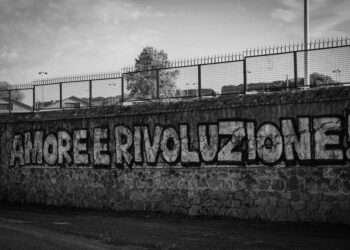
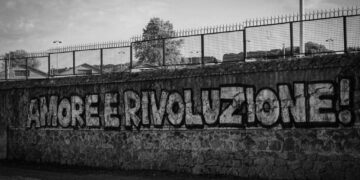
images: (cover 1 – 4) Flammenwerfer, Teatro Argentina, Romaeuropa Festival, Rome, ph: Emma Larsson (3) Blixa Bargeld, Flammenwerfer, Teatro Argentina, Romaeuropa Festival, Rome, ph: Emma Larsson