





In the contemporary performance scene, Simulacro by the KOR’SIA collective stands out as one of the most radical and hypnotic experiences of recent years. Presented at the Romaeuropa Festival and the 2025 Dance Biennale, the show, created by Antonio de Rosa and Mattia Russo, with dramaturgy by Agnès López-Río, is a crossing of gazes, a real and virtual meditation on the body, biological and expanded, and on the image in the age of simulation.
It cannot be defined as a story but rather as a total, immersive experience that envelops the viewer in a perceptual field where living matter and medial matter merge until they become indistinguishable.
In Simulacro, the body is not just a medium for dance: it is an interface, a threshold, a ritual dissolved in networks and their volatile permanence.
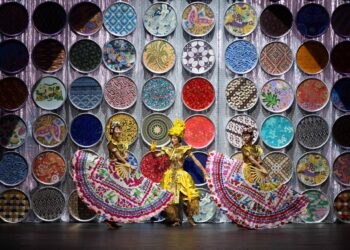
 KOR’SIA creates a space in which light, projections, video and sound act as sensory membranes, passing through the performers and dissolving their contours. The stage becomes an organism: it does not represent, but reacts. Every movement propagates through space as data and emotion, as code and breath. Performative multimedia is the true programming language of the show. The image inhabits and invades the dance: it generates it, disturbs it, prolongs it. At the same time, in a surprising osmosis, light dissects the bodies like an optical scalpel; sound takes the form of the invisible architecture of the visible, the ephemeral structure of the radical nature of bodies in motion. In this unstable balance between flesh and projection, Simulacro questions presence and its copy, gesture and its digital translation, reality and its double. Technology is not a cold device, but sensitive matter, capable of generating flows of data, sensations, perceptions, movements.
The electronic becomes epidermal: light and video adhere to the skin, movement becomes pixels, the body becomes a projection space, sound becomes a tangible network. Multimedia reveals fragility, its vocation for instability and reflection. Simulacro stages the crisis of perception. The performers emerge and dissolve like digital presences, apparitions that slip into the visual flow of an electronic dream. The viewer is immersed in a perceptual threshold where each figure seems to be both alive and artificial. In this ambiguity, where flesh vibrates with light and light seems to sweat, the poetic force of the work is born: a physical reflection on unreality, on virtual liminality, on fiction as an existential condition. De Rosa and Russo’s performance is also a political gesture: an act of bodily resistance within the visual and accumulative excess of contemporary life.

In an age where everything can be simulated, Simulacro restores the body’s original power: that of a fragile, imperfect, fallible, unprogrammable being. Dance becomes a form of survival of experience, a ritual to rediscover an authentic presence within the multiplication of images, a chance to breathe.
For KOR’SIA, performative multimedia is a practice of crossing over, a way of questioning the threshold where vision becomes body and body becomes image. Where art meets technology not to describe it, but to feel it, to transform it into living flesh.
Antonio de Rosa, Mattia Russo, KOR’SIA, Romaeuropa Festival, 07-08.10.2025
Production: Gabriel Blanco, Paola Villegas, Andrea Mendez (Spectare) | Technical Direction: Meritxell Cabanas | Co-production: Centro de Cultura Contemporánea Conde Duque (Madrid, Spain), La Biennale di Venezia, Centro Nazionale di Produzione della Danza ResExtensa | Porta d’Oriente (Bari, Italy), Montpellier Danse – Agora Montpellier (France), Theater Freiburg (Germany) | With the support of: Ministry of Education, Culture and Sport – Government of Spain Community of Madrid, Municipality of Madrid
images: (all) KOR’SIA, «Simulacro», Romaeuropa Festival