




Until 25 October 2025, BUILDING TERZO PIANO in Milan presents The Impossible Present. Caleidoscopio, a site-specific project by Delphine Valli curated by Melania Rossi, which brings together a series of previously unseen works and photographs, texts and installations, in a variety of languages. The exhibition takes place two years after the publication of the book The Impossible Present, published by Parallelo42 Contemporary Art, on the occasion of the artist’s research residency in Marrakech, following her victory of the Italian Council Research Grant in 2021. Arshake is pleased to publish the conversation between Melania Rossi and Delphine Valli that accompanies the exhibition.

Melania Rossi: This exhibition at BUILDING TERZO PIANO brings together works created over time: before, during, and after your artistic residency in Marrakech, which you won in 2021 with the project The Impossible Present, thanks to the Italian Council X call for proposals by the Ministry of Culture.
I find it interesting that you added the word “kaleidoscope” to the title of the exhibition. In fact, all the works on display overlap and refer to each other in an almost spontaneous but orderly way, as happens with memories that collide in the sidereal space of memory. Everything plays between materiality and immateriality, between things that resemble each other on a more subtle level than the rational one, between associations that impose themselves on the eyes, like intuitions or premonitions. Many of your works remind us that we can observe and feel even the most well- trodden paths in a different way, just as happens in the careful wandering of travel, where we discover the world and ourselves.
At the heart of the exhibition, it seems to me, lies what truly remains of lived experiences. As an artist—a sculptor even when working in the field of painting—form and color are characteristics that immediately imprint themselves on your vision and your memory.
They then gradually settle and take on meaning. You told me your story one night five years ago. We were in Marseille for a project in the context of Manifesta 13, and you were creating a work that brought together three places in your life: the Maghreb, France, and Italy.
Considering all the emotional and physical movements, all the memories that will have resurfaced during your journey of reconnection with the Maghreb, which you left at the age of 16 and to which you had not returned until 2022: what does this latest exhibition at BUILDING mean to you, both artistically and personally? And how did it come about?
Delphine Valli: A long development period, I would say. After all, since the publication of The Impossible Present, which marked the end of the research period with the Italian Council, the idea of translating the experience into material and plastic form has become increasingly compelling. I didn’t feel any urgency, but I did feel the need. Then, in October 2023, just when I should have been riding high on the momentum of the book’s publication and the recently completed project, a blanket of black asphalt fell on me and I felt a profound sense of detachment from the reality around me. I felt as if I were evolving in an immense, insignificant but overbearing theater, where every concept was emptied of its substance. During that period, I created the three black cards on display, covering the silver backgrounds I had previously created with smoky black etching ink. For me at that time, the scenes had become obscene.
With you, we wanted to continue the discussion that began in Marrakech, and in 2024, BUILDING offered us this opportunity, accepting our unique proposal, which immediately developed around the book The Impossible Present, published by Parallelo42, which is on display in the exhibition. During its long development process, the project found its form, synthesized in the image of a kaleidoscope, in which the elements respond to each other, repeat themselves, and evolve in a mirror-like fashion. Compared to the project’s growth period, the time it took to complete the project was relatively short. I relied on intuition; each element seemed to impose itself, and I tried not to interfere. As you say, memory works more by superimposition than by juxtaposition, and intuitively, both in the creation of works derived from the research project carried out in Marrakech and in the integration of previous works, or works contemporary to the research period, I identified the meaning of each one at the foundations of my work, revealed in some way by the research period itself. Their co-presence in the exhibition is intended to highlight them rather than analyze them, relying on the evidence of parentage.

The first works of yours that I saw and that pushed me to explore your research further were two Moroccan cement tiles partially hidden by geometric shapes, exhibited in a group show in Rome several years ago. They stood there, pretty but mysterious, harmonious in their strange imbalance. Somehow exotic in that context. Then I started visiting your studio and, over the years, I saw that the shapes of pendulums, triangles, and trapezoids kept reappearing in your works, suggesting that they were fragments of a more complex geometry. Like the intertwining patterns of Moroccan zelliges, the glazed mosaic tiles that are ubiquitous in homes, in the interior gardens of riads, in religious buildings, and in palaces. The centuries-old tradition of applied arts in the Arab world derives from Aristotelian theory of order, which connects the movements of the celestial spheres to the slightest tremors of forms. Unable to represent the divine figure, invisible by nature, traditional Islamic art has internalized the spiritual element. Thus, an apparently simple, decorative image underlies an extremely complex thought. I quote from memory from your text Orientarsi [Orientation]: reality eludes our senses. Today, quantum physics has shown that things are not as they appear, a truth intuited by Eastern philosophies centuries ago. Were you aware of the possible influence of Islamic applied arts on your artistic practice? How might the visual culture you were immersed in during your childhood have influenced your research?
I spent the first 16 years of my life immersed in Islamic culture while attending French school in Algiers. I traveled extensively in Algeria, Morocco, and Tunisia. I grew up between two shores of the Mediterranean. Before returning to the Maghreb in 2022, I was completely unaware of its possible influence on my practice. During my first wanderings in the medina of Marrakech, I was particularly struck by Islamic architecture, its relationship to space, both internal and external, to light, but also to the geometries that pervade it. I felt at home. It was an experience I felt with my whole body, a buried memory that resurfaced because it had not been stimulated. Analytical geometric diagrams were conceived by mathematicians and astronomers around the 9th and 10th centuries, while Islamic art emerged in the 7th century, coinciding with Islam, and spread rapidly from Spain to India. It is an extraordinary feature of Islamic art that it has been assimilated by so many ethnic groups.
I hadn’t been aware of its influence, but in Marrakech I realized that I hadn’t seen what I had internalized: Islamic culture had shaped my sensibility and, in particular, my approach to space and spirituality, which I had also internalized. In my practice, I have always favored intuition, and the language that imposed itself on me was insistently abstract from the very beginning. I imagine that, in a widespread way, what shaped my approach to the world was subsequently revealed in my artistic practice. I feel that this journey of reconnection with the Maghreb has allowed me to begin to consciously integrate the two cultures and frees me from an exclusively abstract injunction.

You told me that the titles of your works come from an automatic generator of contemporary art titles. Some examples: Mechanical Absence, A Lost Information, The Possibility of Orientation, … There is a bit of irony in the pretentiousness of the names—obviously all in English—and also in the choice to delegate the assignment of the title to an automatic system, especially considering that writing is an integral part of your work. Your works are often accompanied by your original texts. Furthermore, you are French, so you think in two languages, with all the interesting shifts in meaning that occur during translation.
There are also many texts in this exhibition, always poetic and characterized by a sensitive use of words. In some cases, there are extrapolated phrases such as: “You never know for whom you are the brightest star.” In other cases, they are found words such as Unico Grand Amour, seen on a wall in the Medina of Marrakech. I mention these two in particular because in the exhibition we see them translated into geometric Arabic calligraphy. And even the twisted rods of the installation The Literature of War refer to the word, because each twist corresponds to a letter of our alphabet. What does writing represent for you, how does it integrate into your visual art and into this exhibition?
The ironic generator of contemporary art titles that you remember no longer exists, but in fact, I chose to draw on my reservoir of self-generated titles for my recent works as well, for consistency with the other works on display. I always like to delegate to chance and to a machine the task of producing meaning, but I don’t delegate the assignment itself; I still choose the title in relation to the work.
When I was a child, I used to mentally translate what I was experiencing, as one would do in a tale. Observation was combined with distance from what I had experienced. Then I discovered literature and poetry in particular. Literary space identifies the space specific to literary works and is a space in its own right. Immaterial and intangible.
At a certain point, I felt the need to integrate writing into my plastic production, in an attempt to bring these spaces closer together and observe what their encounter could generate. For The Impossible Present, I set out to integrate writing into the plastic texture of the work, as is the case in traditional Islamic art. So I created this alphabet, in which each letter corresponds to a specific twist of the iron rod, resulting in a cryptic message contained within the material itself. I also printed two geometric calligraphies in the Kufic style by Abdelghani Ouida, a well-known calligrapher from Marrakech. This time, writing is reunited with abstract form, a favorite in Islamic art.

You are telling us about a return journey, after migrations that have taken you from Paris to Algiers and then back to France, finally arriving in Rome. I remember that while drafting the project for IC, you questioned yourself a lot about the idea of return as heterotopia. In Michel Foucault’s thinking, heterotopias are real but anomalous places that contrast with all other existing spaces. When you return to a familiar place, you can experience a form of heterotopia if you manage to observe it with a renewed perspective. The experience of return can cause a place to “become something other than itself and not different as unknown.” A real return is, in fact, impossible because we cannot return to who we were then, nor can we find ourselves in that same time or place.
I therefore find it interesting that, for political reasons, you were unable to return to Algiers, the city of your childhood, but ended up in Marrakech. As Juan Palao, archivist and philologist, rightly writes in the book published by Parallelo 42: ‘By going to Algiers, Delphine found Marrakech’. After all, “present” in English also means gift: an opportunity was born out of impossibility. Cultural comparison is at the heart of your research, and the images you create are a sort of bridge between different worlds. It is not just about the relationship between East and West, but about
dissolving boundaries by transcending definitions and trivializations, going beyond the thresholds of the possible. In fact, your works often occupy a sort of intermediate space, between two and three dimensions, between drawing and sculpture, where even anthropocentrism seems outdated. Time and space play a fundamental role in this project. The temporal element loses its linearity here and the spatial element becomes evanescent. Between these two concepts, ‘emptiness’ emerges as a field of energy, which also plays a dynamic role in the exhibition. In some ways, we return to a discovery of quantum physics. What can always be found in your work is light, the luminous trajectories of colors or metals, which generate further forms and perspectives. After all, your places are all part of the Mediterranean Basin, and there is a great deal of that light in this exhibition. Then there are also the shadows that tell other stories. I quote from your notes, which in the book have the eloquent title Orientarsi [Orientation]: “(…) for me, the artistic experience is not to be considered separate from the existential one, they do not illustrate each other, they generate each other (…)”.
Yes, this uniqueness of experience, both existential and artistic, is its complexity. The “I am inseparable” of the French writer who lived in Algeria, Hélène Cixious, sums up the impossibility of separation.
It ultimately characterized many aspects of the project that led me to experience a return to the culture in which I grew up in a city, Marrakech, that I did not know. This last aspect was, in fact, a gift. I was freed from the utopia of return in which, as you point out, one does not find what one has left behind, and I was able to devote myself entirely to the memories that emerged in me and to the comparative study of Eastern and Western visual cultures. One book in particular was extremely valuable to me, The Canons of the Gaze. Storia della cultura visiva tra Oriente e Occidente [The Canons of the Gaze: A History of Visual Culture between East and West] by Hans Belting. In essence, Western visual culture has defined its perceptual canon with perspective and the centrality of the human gaze, transforming the world into an image, drawing on the theory of vision of Alhazen, a mathematician and astronomer, a brilliant scientist from Mesopotamia who lived in the 1000s. For Eastern visual culture, the image is collateral (we do not see the same thing through water and through air), it focuses on light rays and has internalized the spiritual aspect. And in the case of its complex geometries, they are not mere decorations but the representation of cosmic laws.
We placed the convergence of knowledge at the center of the project, as can be seen in the book, and this was essential and vital. Through this exchange, I was able to gauge how much artistic research has its own dignity. It does not seek its authority outside its field but is enriched by comparison with other fields and vice versa. The artistic approach, like others, is a way of grasping the world and accessing knowledge or understanding.
Three elements in the exhibition, entitled Ode to Chaotic Meditation, made with antique mirrors, evoke the heterotopia you mention. The mirror is heterotopia par excellence, a utopian and reflective space. It allows us to question the visible world and its solidity or reality. After Marrakech, I did indeed return to Algiers, with a research grant from the French Institute in Algiers. I fully experienced the impossibility of return. Beyond the considerations we can make about it, which are certainly valid—for Foucault, return is both a practice and a heterotopic space “whose rule is to juxtapose in a real place several spaces that are normally incompatible”—I experienced a turmoil that had more to do with time, rather than space, from which I was excluded.
For the Gnawa, a mystical brotherhood in Morocco, exile is not so much about space— geography—as it is about exile from the Self. In this sense, returning to Morocco offered a key to understanding that naturally extended beyond myself. With The Impossible Present. Kaleidoscope, I tried to bring together various spaces in one place, to juxtapose and superimpose various spaces opened up by the founding experience in Marrakech.
(the conversation between Melania Rossi and Delphine Valli accompanies the exhibition)
Delphine Valli. The Impossible Present. Caleidoscopio, curated by Melania Rossi
UILDING TERZO PIANO, until 25.10.2025
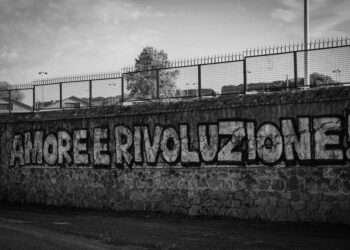
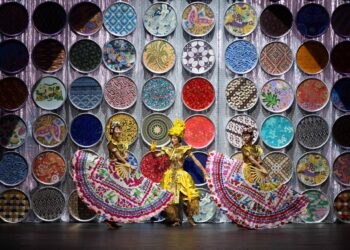
images: (cover 1) Delphine Valli, “The Impossible Present. Caleidoscopio”, BUILDING TERZO PIANO, Milan, photo: Sarah Indriolo (2) Delphine Valli, “A studio The Formation of Joy”, photo: Luis Do Rosario 2025 (3) Delphine Valli, “On Being Superficial”, 2020 2021, The Impossible Present. Caleidoscopio, BUILDING TERZO PIANO, Milan, photo: Sarah Indriolo (4) Delphine Valli, “Progetto per disegno murale”, 2022 2025, The Impossible Present. Caleidoscopio, BUILDING TERZO PIANO, Milan, photo: Sarah Indriolo (5) Delphine Valli, “The Impossible Present. Caleidoscopio”, BUILDING TERZO PIANO, Milan, photo: Sarah Indriolo