




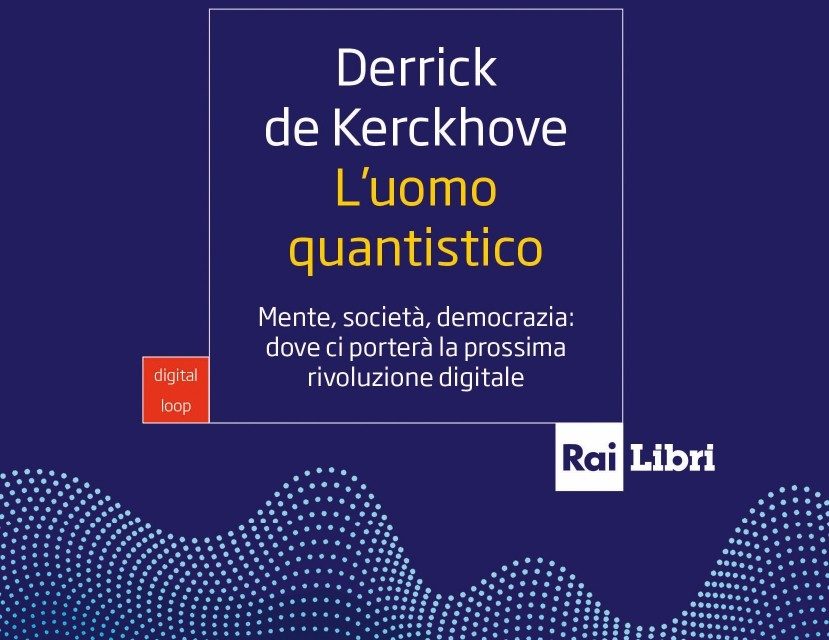
We are faced with a hybrid of epistemic autobiography, a manifesto of trans-subjectivity and a treatise on distributed intelligence’, but also ‘a book on the pedagogy of the future’. This is how Andrea Colamedici describes Derrick de Kerkhove’s L’uomo Quantistico, published by Rai Scuola in 2025, in his afterword.
To all intents and purposes, the book is an experiment and an experience by the Canadian sociologist, who has, once again, put himself on the line in an “exemplary gesture of intellectual vulnerability, a continuous questioning of his own perspective, an honest and demanding search for the co-emergence of meaning”, to use Colamedici’s words once more.
To explore the emerging quantum cultural system – which the Canadian sociologist has identified as following on from the oral, written, typographic and algorithmic systems – de Kerckhove has adopted writing as a cognitive act in the making, a process that has found synergy and collaboration in the combination of the generalised linguistic model Claude (created by Anthropic) and DerrAIck, configured by Matteo Ciastellardi, a lecturer at the Politecnico di Milano, based on concepts and materials developed by de Kerckhove over the course of his years of research and teaching.
The starting point is an analysis of the underlying causes of the epistemic crisis, which the author had already identified in the ‘painful’ transition from the alphabetic operating system to the algorithmic one, and a proposal for ways to realign with the transformations of the contemporary world—an awareness of our entry into a new ‘hypnotic field’, to borrow from Zun’s Hypnocracy, which is also cited in the book as a possible pivotal point in the transition that de Kerckhove identifies from the algorithmic cultural system to the quantum one.
The central question is how to reflect on the epistemological crisis, how to navigate between different information ecologies—the system of knowledge outlined by Bruno Latour—and how to move and act within Donna Haraway’s tentacular system. This gives rise to a multitude of questions:
How can we negotiate between different cognitive and cultural paradigms?
How can we juggle the measured rhythms of traditional narrative with the rapid impulses of algorithmic media?
How can we acknowledge certain paradoxes of reality from this quantum perspective and understand what terms from the language of quantum physics – such as non-local, superposition, entanglement and intra-action (rather than interaction) – truly mean in relation to our ways of existing and acting?
And in all this, what role do humans and creativity play? Our creativity?
These are just some of the many questions that run through the book, inviting us to reflect on them whilst offering us a tool to do so: immersing ourselves in quantum ecology as a new cultural operating system, ‘a new epistemology of reality, where probability takes the place of certainty and coherence replaces sequential logic, where everything is interconnected and continually generated through processes of intra-action’, as the author echoes the words of physicist Karen Barad, agreeing with her in outlining ‘the concept of quantum entanglement as the basis for a new epistemology, in that it is not merely a physical phenomenon but a principle that transforms the way we know’.
The line of thought running through the book, far from being abstract, is used to interpret the contemporary world, to analyse the crisis of democracy by rethinking its values from a new perspective and taking change into account.
In a book that presents itself as ‘a deliberate experiment in cognitive collaboration’, a range of methods are interwoven, from the ancient practices of the Middle Ages to those adopted for machine learning systems such as GANs – Generative Adversarial Networks (where a generator and a discriminator engage in a recursive competitive process to produce an increasingly sophisticated result), revealing a ‘metacognitive dimension that would not have been accessible through unassisted reflection’, as de Kerckhove points out with hindsight in the book’s prologue.
Writing as a way of seeing and an experience of life in the world is explored in the book through the process of its creation, integrating the ideas of other authors such as the aforementioned Donna Haraway, Bruno Latour and Yuk Hui, but also Massimo Di Felice, with whom de Kerckhove co-authored the Manifesto of Digital Citizenship in 2022, building on NaturArchia—the neologism proposed by the sociologist in 2020 to extend humanity towards an ecosystemic citizenship that encompasses the non-human. Marshall McLuhan is revisited in the fifth chapter through the adoption of his tetrad – the four questions for analysing the role of emerging technologies – as a method for examining computational intelligence. The adoption of Gestalt psychology’s figure–ground principle – another distinctive approach of McLuhan’s – in the early chapters helps shed new light on how the phonological character of Western writing systems and the iconic nature of Eastern scripts have been decisive in shaping different worldviews.
All this leads to the ‘quantum human’, a condition governed by indeterminacy as a different form of order based on the recognition of probabilistic patterns, an awareness of inhabiting a reality that is in a state of ceaseless transformation and an image that exists as a process rather than as a finished product.
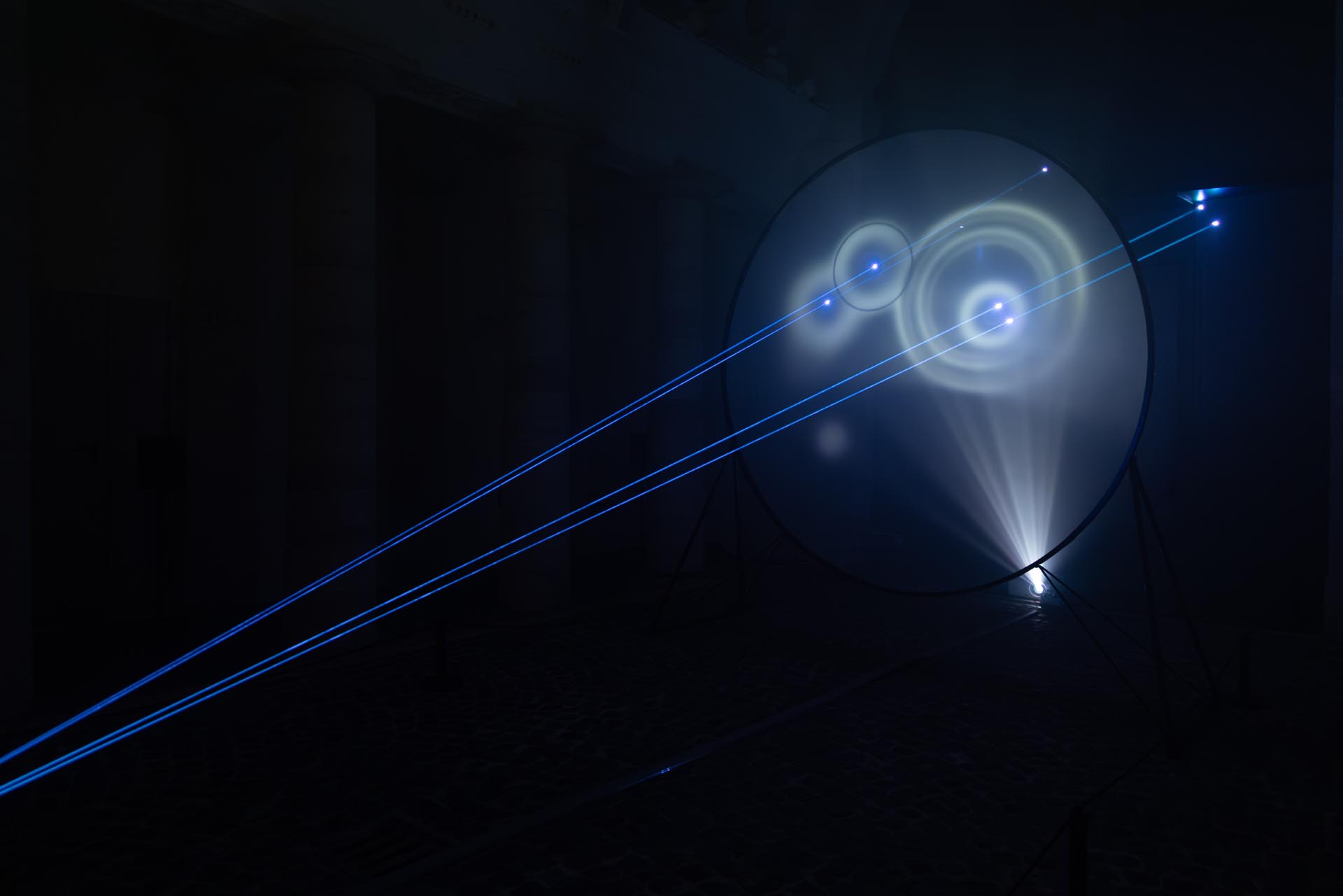
A year after the book’s completion, his open-minded approach has identified and recognised artistic endeavours—such as the transdisciplinary project luster. A Symphony of Data[1], to construct an experiential image of what it means to inhabit this quantum dimension. This is an immersive installation and experience, the culmination of research lasting over a year based on data from particle collisions in CERN’s ATLAS experiment: the data, interpreted by scientists through abstract mathematical, probabilistic and statistical languages, have been translated into visual and auditory forms, offering the sensation of seeing and hearing the Higgs boson and intuitively understanding its fundamental role in the formation of the cosmos.
Franco Speroni described it as ‘a process of transduction that transforms, into aesthetic signals—that is, signals perceptible to our senses—the way mass is created at the subatomic level, thereby broadening our perception and thus our sense of reality in a post-anthropocentric direction’[2]. This also meant placing oneself within the very fabric of things, feeling part of an infinitesimal moment within a potential dimension. It was Speroni himself who, in his reading of de Kerkchove’s book, highlighted an important point: namely, that in the initial phase of his analysis of the epistemic crisis—which also draws on the transition from the alphabet to the internet, as set out in his 2007 historical essay From the Alphabet to the Internet—he ‘contrasts the “point of being” with the “point of view”’. The ‘point of being’ (characteristic of electronic culture) does not create a distance between subject and object, as occurs in the ‘point of view’ typical of the literate individual, particularly within a process of civilisation and normalisation founded on the technocultural apparatus of the book, upon which our histories and our modes of exposition have been structured. The ‘point of being’ is immersive and interacts within the space-time of perception, producing phenomena”[3].
Of all the voices of the authors who have shaped his thinking and who are repeatedly heard throughout the work, Pierre Teilhard de Chardin (1881–1955) appears right at the end, once the process is complete, when the author looks back on his writing process in the epilogue. De Kerckhove reveals to us how The Human Phenomenon, which this priest, Jesuit, scientist and palaeontologist had written in the late 1930s whilst in China (published posthumously in 1955), had shaped his thinking ever since he first read it at the age of 18, and leads him today to conclude that ‘consciousness is evolution turning in on itself to know itself’ – thus proving to be more than mere philosophical speculation. It points to the most practical wisdom there is: the recognition that, by caring for consciousness, we care for the cosmos, and that by caring for the cosmos, we care for the deepest dimension of ourselves’.
It is now clearer how de Kerckhove, moving beyond a mere analysis of the current situation, guides us towards the need to find a way to live with and coexist alongside this paradigm shift. If we cannot aspire to train an artificial intelligence with a cultural background as vast as his own, let us seek other approaches that are ‘tailored’ to us. Above all, he guides us to seek, within the indeterminacy and interconnection of the whole, the role of humankind that we have lost sight of and that we must rediscover in its role and responsibility as ‘planetary citizens’.
Note
¹ CLUSTER. Symphony of Data is a collaborative project between the Academy of Fine Arts in Rome, carried out as part of the European project EAR – Enacting Artistic Research, featuring the scientific research of media artist Cristian Rizzuti, the theoretical guidance of Biagio Di Micco (Roma Tre University and INFN), and the collaboration of Riccardo Torresi (media artist) and Julian Alvarez (sound artist), students from the Academy of Fine Arts in Rome (Giovanni Pio Appoloni, Idea Carmosino, Federica Davide, Lidia De Nuzzo, Federico Tidei, Aurora Tittarelli), PhD student Romano Orlandini (Roma Tre University and INFN) and researcher Federico Montereali (INFN). Cfr. D. De Kerckhove, Cluster: Symphony of Data: espressione del dialogo tra arte e scienza, “mediaduemila”, 26 marzo 2026, https://www.media2000.it/cluster-symphony-of-data-espressione-del-dialogo-tra-arte-e-scienza/
² Speroni, Iconologia dell’invisibile. Il caso Cluster: Symphony of Data, “Operavivamagazine”, 2 July 2026
³ Franco Speroni, Ibidem.
Derrick de Kerckhove, L’uomo Quantistico. Mente, società, democrazia: dove ci porterà la prossima rivoluzione digitale
Rai Scuola, 2025 (Italian)
images: (cover 1) D. de Kerckhove. L’uomo quantistico, copertina del libro (2) CLUSTER. Symphony of Data. Installation view, Galleria dell’Accademia di Belle Arti di Roma. ph Monkeys VIdeo Lab