




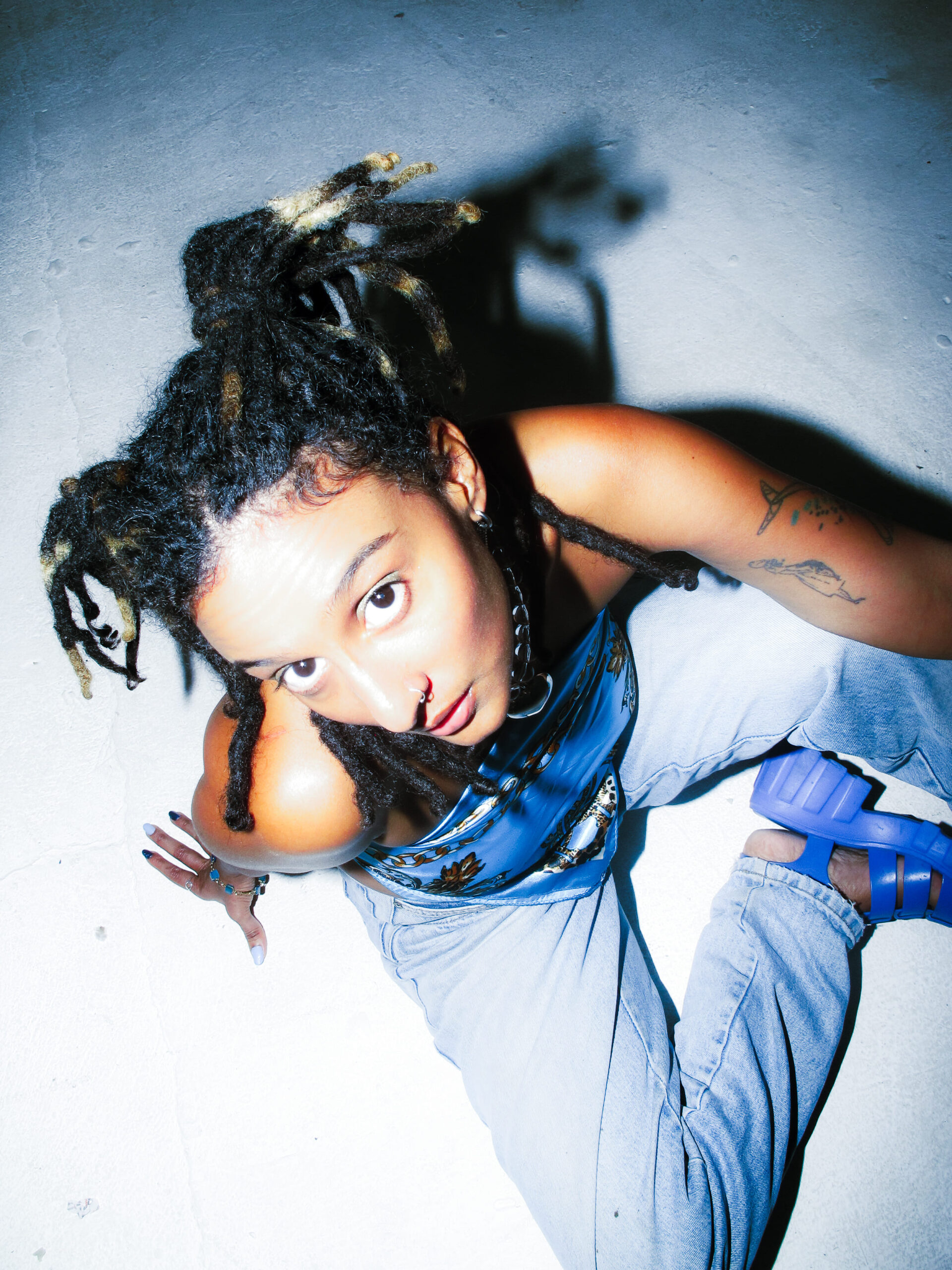
To mark Interference. The image is never just an image, an exhibition curated by Vertov Project – Francesca Leoni and Davide Mastrangelo – at the Fondazione Dino Zoli in Forlì as part of the Ibrida Festival 2026, we dialogued via email with biarritzzz, a young Brazilian transmedia and ‘anti-disciplinary’ artist whose practice explores digital languages, memory, spirituality and popular culture.
Her work is part of the exhibition that brings together twelve international female artists around the concept of ‘interference’, understood not as an error or disruption to be eliminated, but as an opportunity for deviation, transformation and openness to the unexpected. We asked biarritzz how her work fits into this framework of interference, bearing in mind her unique position as an anti-disciplinary artist and her life and culture, steeped in the ancestral knowledge of north-eastern Brazil, her homeland. We asked her how, and in what spirit, this cultural heritage guides her in her use of technology and at the intersection of pre-colonial cosmologies and a hyper-technologised world.
Elena Giulia Rossi: According to the curators Francesca Leoni and Davide Mastrangelo, the exhibition explores what we inherit, what we forget and what we build together with the technologies in which we live, conceiving the digital not simply as a tool, but as an environment, a language and a critical possibility. In your work, what does it mean to ‘inhabit’ a technology? And to what extent does what we inherit — culturally, symbolically, ancestrally — influence the way we inhabit the digital realm?
biarritzz: We inhabit different technologies in our everyday lives, and that doesn’t mean the digital or electronic technologies only. We live inside our different worldviews and cosmologies, and those are also technologies of encounter or dis-encounter. That means the digital carries many other technologies inside of its mechanisms, platforms, communication techniques. There’s always something very traditional in everything human life does, even when all-covered with the ‘new’. Which means the machine is, in the end, very very human. And yet, it will never be one. We will always inhabit the digital as humans, and humanity on its many layers must be priority, because it’s all we have.
How does ‘Cápsula de Respirar’, the work currently on display at the ‘Interferenze’ exhibition, fit into this concept? And what does the use of technology mean to you?
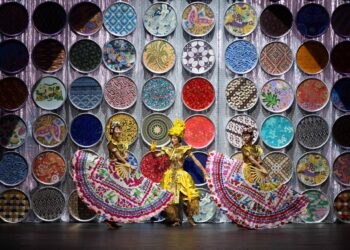
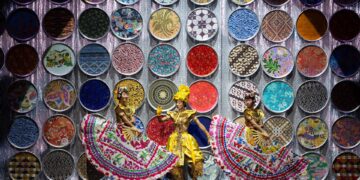
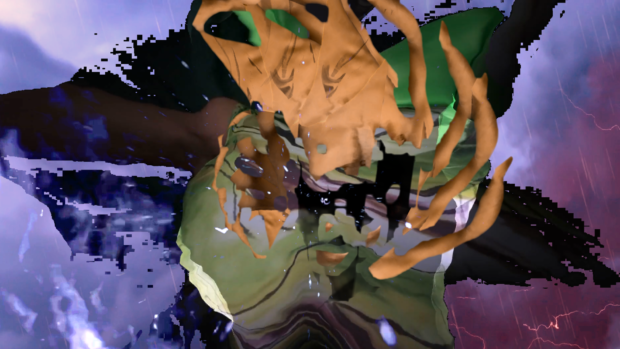
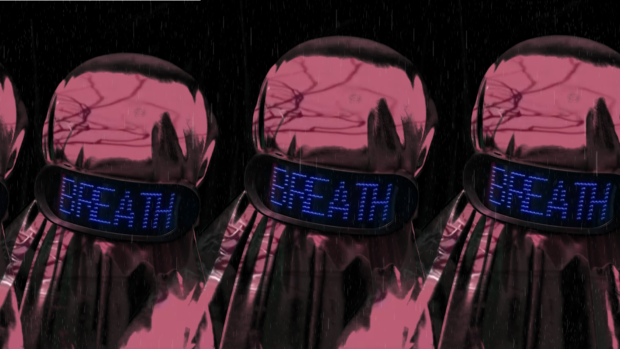
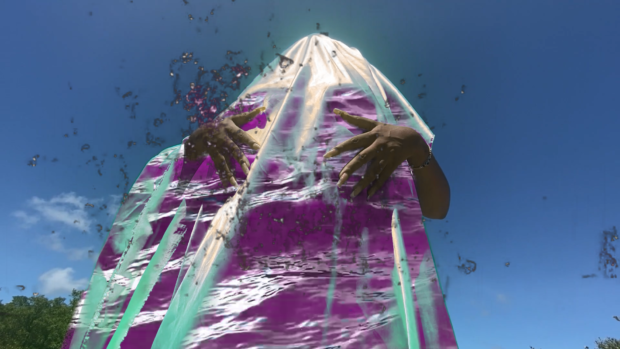
This work talks about a river that is painted pink by a toxic material that comes from the jeans industry. This river (Capibaribe) then talks as an entity, as a human-form being, to cry its poetry. Giving a human form to nature elements is a mechanism many traditional peoples carry to relate to them. A river and a forest are more human than us because they are here before us, therefore we came from them. We use the available technology to talk about this. My aesthetics are a consequence of what surrounds me and that’s why the digital is so present: those are the tools I have in my hands.
You were born in Fortaleza and now live in Salvador, two very different places, but both shaped by indigenous, African, colonial and diaspora histories. To what extent do these places influence the way you conceive of and use technology?
Growing up and living in the Brazilian Northeast, also considered the poorest region of the country, is paradoxically about being in touch with the richest culture, music, dance and traditional manifestations of different native and African origins. The body, the collectiveness and the spontaneous are very important elements behind what is created poetically, artistically in these manifestations. I’m in a process of understanding how these manifestations influence the way we deal with the digital and the body in virtual contexts. And this process is making me study the Brazilian meme, which influences many of my works, in a more in-depth way.
In your biography, you state that you use magic and low-tech solutions as counter-narratives to help you navigate the current ‘cosmological dispute over realities’. What does this mean to you?
I investigate the low resolution as a counter-narrative to the current global scenario where there is a dispute between images, between what looks more real, which equipments and cameras capture the biggest resolution, and this is a cruel industry, fulled up with minerals extracted with wars and scarcity, whether in Congo or in Minas Gerais, in Brazil. So low resolution can also be understood as a discourse that refuses this industry and the obsolescence culture it aims to spread. Magic comes as practices of communications prior to digital equipment. Specifically pre colonial spiritualities. Both are devices that can refigurate world-views that are based on exploitation and the scarcity of natural sources.
biarritzzz (1994), Fortaleza, lives and works in Salvador, Brazil) is an anti-disciplinary transmedia artist who investigates languages, codes and media. She believes that magic and the low resolution are important counter-narratives to live the current cosmological dispute of realities. Her practice is centered on a quest to dismantle formats, genres, and expectations, as well as on developing the research projects “Meme Pedagogics” and “Countermodern Antifuturisms” as poetic and political tools. She has participated in exhibitions at The Mercosul Biennial 2025, Museu de Arte do Rio (MAR), MASP, Museu do Amanhã, Kunsthall Trondheim, State Of Concept Athens, Delfina Foundation, Pivô Arte e Pesquisa, A.I.R Gallery, Centro Cultural São Paulo, The Wrong Biennale, FILE, The Shed NY, MAM SP, among others. She is part of the collections of Rhizome Artbase (New Museum), KADIST Foundation, Museu Nacional da República and Instituto Moreira Salles. She was a 2023 and 2024 Pipa Award nominee. Is currently a K21 Global Art Award 2026 nominee.
biarritzzz’s work is part of Interference. The image is never just an image, curated by Vertov Project (Francesca Leoni, Davide Mastrangelo), Fondazione Dino Zoli, Forlì, 1 September–11 October 2026. Visit the website here for the exhibition opening hours (free admission) and for the updated and full programme of the Ibrida Festival, 17–20 September 2026
The exhibition is sponsored by the Department of Culture and the Department for Equal Opportunities of Forlì City Council, the Emilia-Romagna Region and the Cassa dei Risparmi Foundation. It is supported by the BCCs of Ravenna, Forlì and Imola, and by Romagna Iniziative. Featuring works by: Chiara Passa, Rä di Martino, Rebecca Merlic, Anaisa Franco, Elena Bellantoni, Francesca Grilli, Giuliana Cunéaz, Debora Hirsch, Kika Nicolela, Aline Motta, biarritzzz and Özge Samancı.
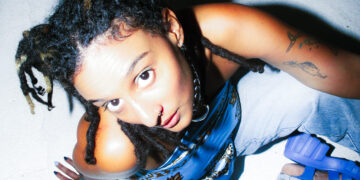
images: (cover 1) biarritzzz, portrait, ph: Yaraçá Silva (2-4) biarritzzz, «Capsula de Respirar (Breath Pod)», 2023, still from video