






The Haiti Pavilion opened on May 9 at the 61st Venice Art Biennale with the installation Yelena’s Garden by artist Enock Placide, curated by Mario Savini and presented at Palazzo Albrizzi-Capello, located in the San Polo district in the heart of Venice.
Enock’s work creates an immersive and relational experience that enhances its value by inviting public participation within a perceptual field that combines painting, moving images, and interaction, aiming to redefine the connection between the visible and the invisible. The Republic of Haiti’s presence at the Biennale serves to promote cultural dialogue and global narratives.
In conversation with curator Mario Savini…

Laura Catini: How does artist Enock’s immersive installation seek to promote cultural dialogue and global narratives within the context of the Biennale?
Mauro Savini: Enock Placide’s installation promotes cultural dialogue not through a didactic representation of Haitian identity, but by creating a space open to connection and shared experience. Yelena’s Garden does not impose a single or closed narrative: rather, it invites the public to move through the work, to temporarily alter its configurations, and to actively participate in the construction of meaning. In this way, the pavilion becomes a meeting place for different sensibilities, memories, and perceptions. The immersive and participatory nature of the installation allows visitors from diverse cultural backgrounds to engage with the work in a direct and personal way. In the context of the Biennale, this approach takes on particular significance, as it transforms the pavilion into a dynamic space capable of generating connections and new possibilities for dialogue beyond national or geographical affiliations.

What does the continuous transformation and evolution of the elements within the fluid, open hexagonal perimeter—understood as a volatile psychic and relational geometry—seek to represent?
The continuous transformation of the elements in the installation represents, first and foremost, the idea of an unfinished work, open to change and connection. The hexagonal configuration should not be understood as a rigid or symbolic structure in the traditional sense, but as a dynamic field of possibilities in which each element can alter its meaning in relation to the presence of the public. The intervention of visitors, invited to move the canvases and create temporary configurations, introduces an unstable and processual dimension. The work changes continuously, not only in space, but also in time and perception. This “open perimeter” thus reflects a relational conception of art: not a closed and definitive space, but a traversable structure, capable of accommodating transformations, connections, and new interpretations. In this sense, becoming becomes part of the work itself.
In addition to paintings on rectangular and circular canvases and a brush painted on both sides, there is also a glass sphere and a video. How have the glass element and the presence of post-digital technology contributed to expanding the meaning conveyed by the works? And how does this relate to the artist’s poetics? Was this a necessary combination to convey the intended meaning, also in relation to the approach pursued by our era?
The presence of the glass sphere and the video element expands the pictorial dimension of the installation, transforming it into a more complex and immersive experience. It is not simply a matter of adding technological elements to painting, but of constructing a perceptual system in which images, reflections, movement, and space are in constant interaction. The glass sphere introduces the idea of a relative and mutable perception. Depending on the visitor’s position, the space and the works are reflected and transformed, suggesting that there is no single stable or definitive viewpoint. The video, on the other hand, introduces a temporal and dynamic dimension into the installation. The painting does not remain isolated as a static image, but engages in a dialogue with movement, with light, and with a fluid temporality that permeates the entire environment. This relationship between material elements and technological presence is very consistent with Enock Placide’s poetics, which tends to conceive the work as an open organism, capable of connecting the sensory dimension, cosmological perception, and audience participation. Rather than speaking of technology in the strict sense, I believe it is important to emphasize how these elements contribute to constructing a form of contemporary experience in which physical space, image, and perception are increasingly interconnected.

In what way can the temporal dimension be identified as a central focus for the exhibition?
The temporal dimension is central to the exhibition because the work never presents itself as a stable or definitive form. Yelena’s Garden is conceived as an open system, in constant transformation, in which each configuration exists only temporarily. The public itself contributes to this dimension of becoming: by moving the canvases and altering the relationships between the elements, visitors produce ever-changing arrangements. The work changes over time, but it also changes through the time of individual experience. The video, too, introduces a fluid temporality that traverses the exhibition space, while the presence of the glass sphere suggests an unstable and relative perception of reality. Nothing appears definitively fixed: everything seems to be in a state of continuous transition. In this sense, time is not simply a theme of the exhibition, but a structural component of the work itself. The exhibition exists through its continuous transformation and through its changing relationship with those who experience it.
Returning to painting, can we define the artist’s painterly choices as a unicum for Haiti and, broadening our perspective further, even at the international level?
Enock Placide’s painterly choices certainly stand out for their strong originality and highly personal approach, which is difficult to assimilate into a specific “movement” or an already codified language. Rather than speaking of a “unique phenomenon” in an absolute sense, I believe it is important to recognize the singularity of his artistic journey and his vision. His painting, in fact, brings together very different elements: the cosmological dimension, sensory perception, memory, abstraction, and spatial construction. The canvases do not function simply as autonomous images, but as parts of a broader system, open to transformation and to dialogue with the space and the audience. Even on the international scene, Placide’s work maintains a rather autonomous position. His practice develops a personal reflection on the relationship between painting, immersive experience, and the relational dimension of the work. It is precisely this freedom of language, combined with the ability to hold together poetic dimension and conceptual construction, that makes his work particularly interesting in the contemporary context.

Is it possible, however, to link it to some already theorized contemporary painting practices?
It is possible to identify some affinities with contemporary practices that conceive of painting no longer as an isolated image, but as a spatial, relational, and immersive experience. However, I believe that Enock Placide’s work maintains a strong autonomy and deliberately eludes overly rigid definitions or unambiguous references.
What does the reference to the micro-macro—pertaining to the natural world and the link between perception, cosmology, and the natural imagination—aim to introduce us to?
The reference to the micro and the macro first and foremost introduces a reflection on the relationship between human beings, nature, and the cosmic dimension. In Enock Placide’s work, seemingly distant elements (the minute detail and the vastness of the universe) are in constant dialogue, suggesting an interconnected vision of reality. The painting, the glass sphere, and the video contribute to constructing an unstable and fluid perception of space, in which the visitor is invited to move between the sensory dimension, the natural imagination, and cosmological openness. However, this is not a scientific representation of the cosmos or nature. Rather, the installation seeks to evoke a perceptual condition: the sensation of belonging to a larger, ever-changing system in which every element is related to the others. In this sense, the micro and the macro also become a metaphor for our contemporary experience suspended between the individual dimension and the global horizon.
During the opening, there was talk of symbolic forms and numerology. What connection can we find with Enock’s artistic practice?
In Enock Placide’s work, certain geometric and symbolic elements certainly contribute to constructing a perceptual and relational dimension of the piece. However, I do not believe it is necessary to interpret them through rigid numerological readings. The open configuration of the installation, the presence of circular forms, the hexagonal structure, and the relationship between the elements seem rather to suggest an idea of dynamic balance, connection, and continuous transformation. Rather than conveying a closed symbolic system, the work constructs a space of resonances and relationships, in which geometry, perception, and movement contribute to generating an immersive experience open to the public’s interpretation. In this sense, the forms take on a poetic and perceptual value even before a strictly symbolic one.
Padiglione Haiti, Enock Placide. Yelena’s Garden, curated by Mario Savini, 61st Venice Art Biennale
Palazzo Albrizzi – Capello Cannaregio 4118, Venezia,09.05-22.11.2026
Commissioner: S.E. Gandy Thomas, Ambasssador of the Repubblic of Haiti in Italy Italia and Permanent Representative of the United Nations Agencies based in Rome
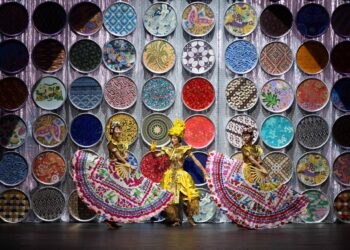
images: (cover 1-2) Enock Placide, «Yelena’s Garden», 2025 – 26, 61st Venice Art Biennale (detail), (3) Enock Placide, «Yelena’s Garden», 2025 – 26, 61st Venice Art Biennale, installation view, variable dimensions