





The installation “Trame di comunità” by international artist Lucy Orta is on view at Palazzo Mugloni, the home of CasermArcheologica in Sansepolcro (AR), curated by Simonetta Carbonaro, through July 15. The CasermArcheologica project is part of the residency and exhibition program supported by Fondazione CR Firenze, in collaboration with REALISE and Lucy + Jorge ORTA, with institutional support from the Municipality of Sansepolcro, the Municipality of Anghiari, and the Madonna del Parto Civic Museums, and with the support of Busatti, Tecnothermo, Ilvio Gallo, Zotti & Coulon, Fondazione Progetto Valtiberina, and Sintagmi.
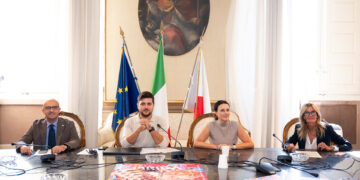
The exhibition opened with a preview attended by institutional representatives on Friday, February 27, featuring remarks by Cristina Manetti, the Regional Councilor for Culture of the Tuscany Region, Barbara Tosti, Head of the Art, Activities, and Cultural Heritage Department at Fondazione CR Firenze; Francesca Mercati, Councilor for Culture of the Municipality of Sansepolcro; along with other representatives from local administrations, starting with the Municipality of Anghiari, which is hosting some of the events that are part of the overall project. The following day, the general public was invited to a meeting with Lucy and Jorge Orta, moderated by the curator and the philosopher and art historian Giuliano Corti. The discussion focused on the theme of participatory art and its role in processes of cultural transformation and social regeneration. A video created by Ilvio Gallo was then presented, poetically documenting the artist’s encounter with the Valtiberina region, incorporating visual contributions from Luca Zotti and Adrian Coulon, young artists with international experience who were involved during the residency, an exploratory period for Lucy Orta, during which she explored the region’s artistic heritage, traversed its landscapes, and visited some of the Franciscan sites in the valley.

If one wishes to refer to an icon that unites the human and the divine in Vasari’s world, it is worth revisiting the words first of Vasari and then of the philosopher Massimo Cacciari, who attests to the unfolding of the divine within Piero della Francesca’s work “Madonna del Parto”. An excerpt from the text in “The Passion According to Mary” (“Icons – Thinking in Images,” il Mulino, Bologna 2024, pp. 136): “… The numbers that define this Woman are composed in a perfect Order, giving life to a cosmos, a coincidence-concord of the Infinite and the finite. Only a cosmos, in fact, can be a true image, an icon however condensed of the Infinite. The Infinite expresses itself in the perfection of harmony, in the elimination of every indefinite note. This figure has conquered the àlogon, the àmetron, the absence of proportion, the lack of measure, which are evil. She has placed this evil under her heel. In her form, the divine design of the world is manifested. At the center of this cosmos, its living heart, is the Woman, the cosmos of the cosmos. In it, the divine is received, continually regenerating it. …”.

It is helpful to begin with these verses to understand the meaning that artist Lucy Orta attributes to the element of the “tent,” which she employs in her relational and participatory installation at CasermArcheologica in Sansepolcro (AR). For the artist, the tent is a fragile and fluid form of architecture that offers necessary shelter during transitions, such as that of the community inhabiting the residential area that has undergone an urban regeneration process redeveloping the former Carabinieri Barracks within Palazzo Muglioni, a historic building in the city center where the work originated: the Valtiberina area, in Sansepolcro, today one of Italy’s most dynamic centers for cultural production. It is, moreover, an archetype of sacred and protective space, a place to gather, as Cacciari’s verses clearly attest, where motherhood, earth and sky, the intimate sphere and the cosmic infinite, and the image of the threshold that separates and, at the same time, allows for Revelation, converge: “…marking the threshold yet distant from its height, the Angels … lift the veil and finally let us see. Apokàlypsis, time of Revelation. The place opens, what was dark is revealed, the lucus is illuminated and dissolves every ancient boundary into the Open. The novitas finally bursts forth free from the darkness that covered it. …”.
We can therefore say that the territory of Sansepolcro is intrinsically endowed with a seed that, even centuries later, a time in which customs have certainly changed, sprouts and blossoms, restoring to us a union between the human and the divine and an epiphany of revelation that crosses the threshold, offering “openness.”

Curator Simonetta Carbonaro’s words particularly highlight the meaning the artist seeks to convey: “With this installation, Lucy Orta does not merely represent a community: she calls it into existence.” From the meanings recorded thus far emerges the title of the installation, “Trame di Comunità” (“Community Weaves”), a work that, by addressing the most intimate epicenter of the community in transformation, denotes a close connection with the artist’s research and poetics, directed toward a constant social commitment and themes such as migration, environmental protection, human rights, and community building.
Lucy Orta has delved into the very soul of the place she explored, has presided over – not to say mastered – its most human and sacred aspects embedded in its history, and has then entered into dialogue with its inhabitants. The question posed to the community, comprising thirty-three people, including artisans, artists, teachers, entrepreneurs, activists, and citizens of various ages, during the residency relates to personal experience and the identity of the territory: “What connects you to this land, and what repels you?”
The idea, derived from the responses received, has been transformed into an installation consisting of five sculptures, a camp of five tents woven from linen and hemp, a “sacred” space for gathering that initiates the process of “community building”, a symbolic and tangible symbol of resistance.

The tents, covered with the thirty-three sewn faces, become a vessel onto which the community projects its realities and utopias regarding who and what it is. They metamorphose into thresholds of Rediscovery, centers of identity for a community in transformation, where wholeness, will, affectivity, rationality, and the sensitive sphere come into play. The polis becomes a chorus, audible within the tents, where distinct paths bear witness to a single journey undertaken to date in the land of belonging and the discovery of its own future, of its “possible utopias” which – as the motto of CasermArcheologica states – “constitute the driving force that continues to weave the threads of our communities, guiding them toward the construction of desirable futures.”
If linen fabrics are the material and moral memory of the land, a link between the physical self, the community, and the place of belonging, and the golden pearls, emerging from the suspended threads of the faces, evoke fragility, the possibility of transformation, and the rebirth into new beauty, the ninety-nine small, hand-molded terracotta artifacts, dangling and anchored to the fabrics, serve as amulets, evoking the distinctive architecture and nature of the place and the resilient community. Recognizing fragility is not a sign of weakness; on the contrary, it is an authentic acknowledgment of the human condition that drives us to perceive our own limits, moving toward the search for courage, deep connections, and the other. It is one of the principles of being and of our existence.
Lucy Orta, Trame di Comunità, CasermArcheologica, CasermArcheologica, Sansepolcro, Italy, 28.02 – 15.07. 2026
images (all): Lucy Orta, Trame di Comunità, CasermArcheologica, 2026. Ph. Ilvio Gallo