
Your browser does not support the video tag.
Marco Cadioli - The Whirlpool
  • © ARSHAKE | ISSN 2283-3676
  • CONTACT
  • Login
Arshake
  • ABOUT US
    • ABOUT US
    • PROJECT
    • MEDIA/PARTNERSHIPS
    • CONTACT US
  • FOCUS
    • All
    • Focus
    • From the Past
    • Interview
    A Body Engineered by Water – In Dialogue with Claudia Amatruda 

    A Body Engineered by Water – In Dialogue with Claudia Amatruda 

    Daniele Puppi. Ehi Lampu in Rome

    Daniele Puppi. Ehi Lampu in Rome

    Interview | C.I.R.C.E.

    In dialogue with Abe Pazos Solatie

    Interview | C.I.R.C.E.

    Interview | C.I.R.C.E.

    Fabrizio Cicero. This is not a light

    Fabrizio Cicero. This is not a light

    Legami by Luigi Pagliarini now at ISIA Pescara

    Legami by Luigi Pagliarini now at ISIA Pescara

    Lynn Hershman Leeson. A lecture at the Whitney Museum of American Art

    Lynn Hershman Leeson. A lecture at the Whitney Museum of American Art

    Festival della Peste at Lazzaretto Foundation

    Agnese Banti at Romaeuropa Festival 2025

    Open call: Agora, a Gathering of Art and Philosophy

    Open call: Agora, a Gathering of Art and Philosophy

  • FRAME
    FRAME > The Fall of Icarus

    FRAME > The Fall of Icarus

    FRAME > Resonant

    FRAME > Resonant

    FRAME > City

    FRAME > City

    FRAME > Magnetism

    FRAME > Magnetism

    FRAME > You Are Here

    FRAME > You Are Here

    FRAME > Gdansk

    FRAME > Gdansk

    FRAME > Cicadas

    FRAME > Cicadas

    FRAME > Dalunsch

    FRAME > Dalunsch

    FRAME > Siren

    FRAME > Siren

  • VIDEO POST
    VIDEO POST > Scribble

    VIDEO POST > Scribble

    VIDEO POST > The Prayer

    VIDEO POST > The Prayer

    VIDEO POST > Organism

    VIDEO POST > Organism

    VIDEO POST > Chiroptera

    VIDEO POST > Chiroptera

    VIDEO POST > Pluvial

    VIDEO POST > Pluvial

    VIDEO POST > PAPERS

    VIDEO POST > PAPERS

    VIDEO POST > Stranger Visions

    VIDEO POST > Stranger Visions

    VIDEO POST > Buoyant Choreographies

    VIDEO POST > Buoyant Choreographies

    VIDEO POST > Composition for Objective Sound No.7

    VIDEO POST > Composition for Objective Sound No.7

  • SPECIAL PROJECT
    • ARSHAKE’S BANNER
    • CRITICAL GROUNDS
    • YOUNG ITALIAN ARTISTS
    • GAME OVER
    • GAME OVER • Loading
    • EXTERNAL PROJECTS
      • BACKSTAGE | ONSTAGE
      • PERCORSI • 6 years of the Terna Prize
      • TEMPO IMPERFETTO
  • RESOURCES
    • ARCHIVE
    • CALLS
    • ONLINE RESOUCES
  • it IT
  • en English
No Result
View All Result
Arshake
  • ABOUT US
    • ABOUT US
    • PROJECT
    • MEDIA/PARTNERSHIPS
    • CONTACT US
  • FOCUS
    • All
    • Focus
    • From the Past
    • Interview
    A Body Engineered by Water – In Dialogue with Claudia Amatruda 

    A Body Engineered by Water – In Dialogue with Claudia Amatruda 

    Daniele Puppi. Ehi Lampu in Rome

    Daniele Puppi. Ehi Lampu in Rome

    Interview | C.I.R.C.E.

    In dialogue with Abe Pazos Solatie

    Interview | C.I.R.C.E.

    Interview | C.I.R.C.E.

    Fabrizio Cicero. This is not a light

    Fabrizio Cicero. This is not a light

    Legami by Luigi Pagliarini now at ISIA Pescara

    Legami by Luigi Pagliarini now at ISIA Pescara

    Lynn Hershman Leeson. A lecture at the Whitney Museum of American Art

    Lynn Hershman Leeson. A lecture at the Whitney Museum of American Art

    Festival della Peste at Lazzaretto Foundation

    Agnese Banti at Romaeuropa Festival 2025

    Open call: Agora, a Gathering of Art and Philosophy

    Open call: Agora, a Gathering of Art and Philosophy

  • FRAME
    FRAME > The Fall of Icarus

    FRAME > The Fall of Icarus

    FRAME > Resonant

    FRAME > Resonant

    FRAME > City

    FRAME > City

    FRAME > Magnetism

    FRAME > Magnetism

    FRAME > You Are Here

    FRAME > You Are Here

    FRAME > Gdansk

    FRAME > Gdansk

    FRAME > Cicadas

    FRAME > Cicadas

    FRAME > Dalunsch

    FRAME > Dalunsch

    FRAME > Siren

    FRAME > Siren

  • VIDEO POST
    VIDEO POST > Scribble

    VIDEO POST > Scribble

    VIDEO POST > The Prayer

    VIDEO POST > The Prayer

    VIDEO POST > Organism

    VIDEO POST > Organism

    VIDEO POST > Chiroptera

    VIDEO POST > Chiroptera

    VIDEO POST > Pluvial

    VIDEO POST > Pluvial

    VIDEO POST > PAPERS

    VIDEO POST > PAPERS

    VIDEO POST > Stranger Visions

    VIDEO POST > Stranger Visions

    VIDEO POST > Buoyant Choreographies

    VIDEO POST > Buoyant Choreographies

    VIDEO POST > Composition for Objective Sound No.7

    VIDEO POST > Composition for Objective Sound No.7

  • SPECIAL PROJECT
    • ARSHAKE’S BANNER
    • CRITICAL GROUNDS
    • YOUNG ITALIAN ARTISTS
    • GAME OVER
    • GAME OVER • Loading
    • EXTERNAL PROJECTS
      • BACKSTAGE | ONSTAGE
      • PERCORSI • 6 years of the Terna Prize
      • TEMPO IMPERFETTO
  • RESOURCES
    • ARCHIVE
    • CALLS
    • ONLINE RESOUCES
No Result
View All Result
Arshake
No Result
View All Result
Home exhibitions

The “non finito” between Michelangelo and Quayola

Fabio Giagnacovo by Fabio Giagnacovo
14/03/2022
in exhibitions, Focus
The “non finito” between Michelangelo and Quayola

The “non finito” (unfinished) sculpture, as an existential metaphor for two different zeitgeists, shows us the transformation of our deepest fears and disturbances over time. While in the Renaissance this was mediated by Catholicism, in our time the fluid nature of digital technology inevitably plays the most important part.

Prisoners and Pietà Rondanini are the greatest examples of Michelangelo’s non finito works. Representing a real fracture with classicism – the restless and perpetually unsatisfied genius had been contemplating this throughout his life – it only matured in his final acts. Michelangelo, as we know, maintained that the work of art was already present in the block of marble and his task was teleological – revealing it through the immortal tools of sculpture, the mallet and chisel.
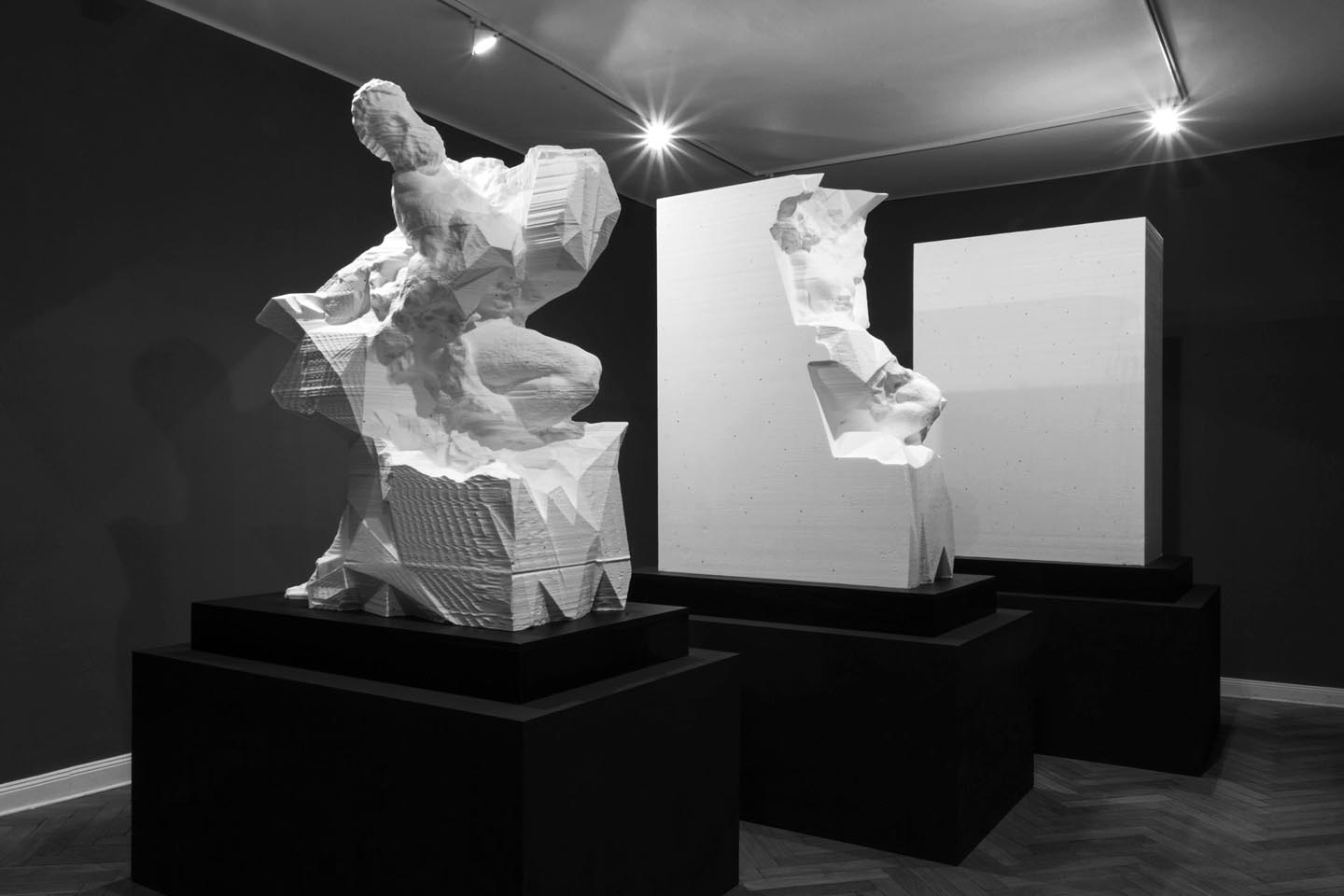
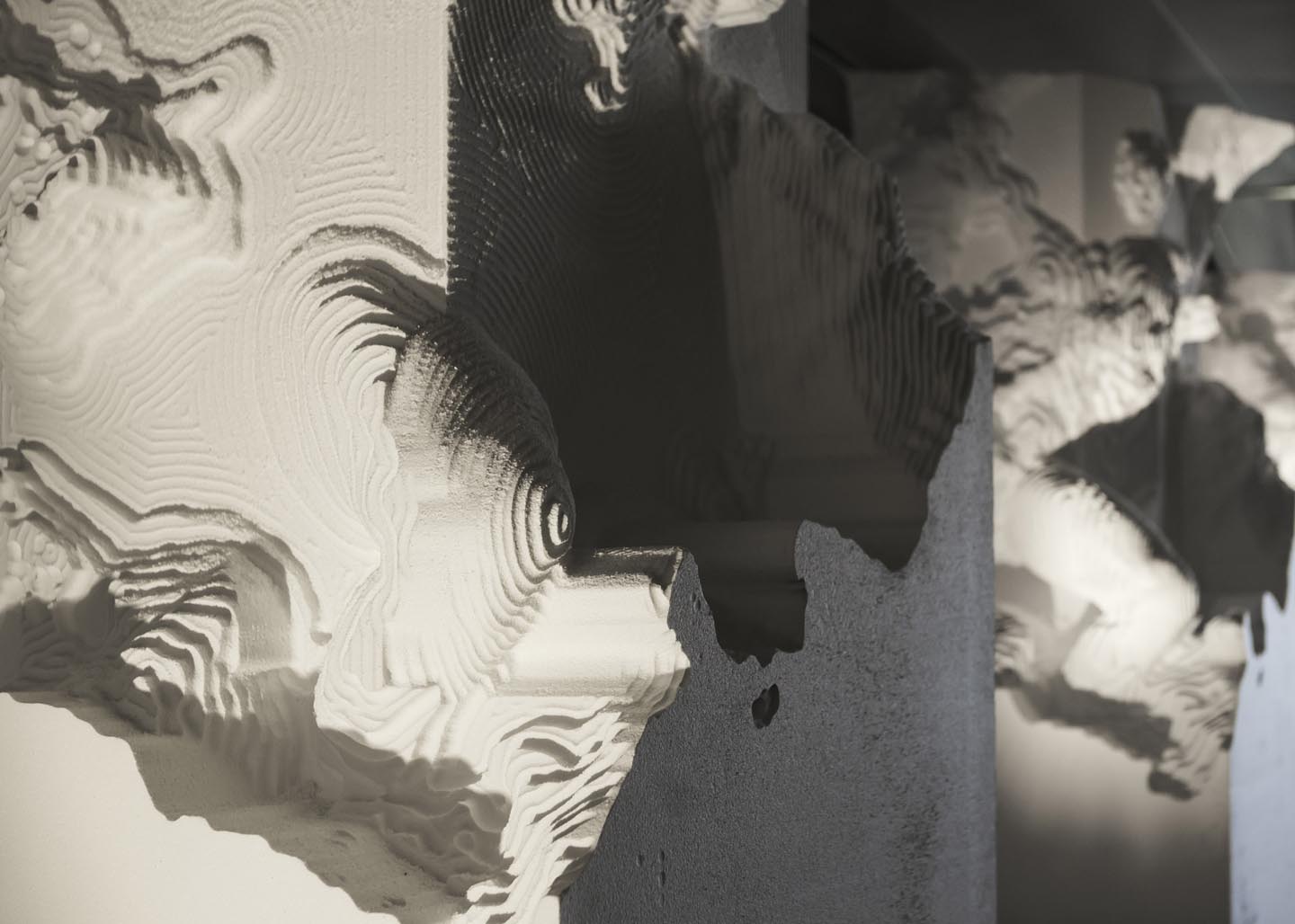
Davide Quayola was born more than half a century later and the tools he prefers to use are digital, composed of algorithms and artificial intelligence. Among his fascinating works we find the Michelangelo topos of the non finito. This non finito work is very different from that of Prisoners. Although reminiscent of a system of thought that was highly characteristic of the Renaissance crisis and, from then on, always present in the history of art, this work distorts meaning, showing something very different underneath.

Quayola’s non finito works, developed in several projects over the past decade, are created by a mechanical arm connected to an AI consisting of algorithms, which the artist programs and puts to work on three-dimensional scans of classical sculptures. By showing the results, and often even the creation process of these pieces through the work of the mechanical arm, enormous differences and interesting points of contact with Michelangelo’s sculptures can be noted in the ontological essence of the artefact itself.
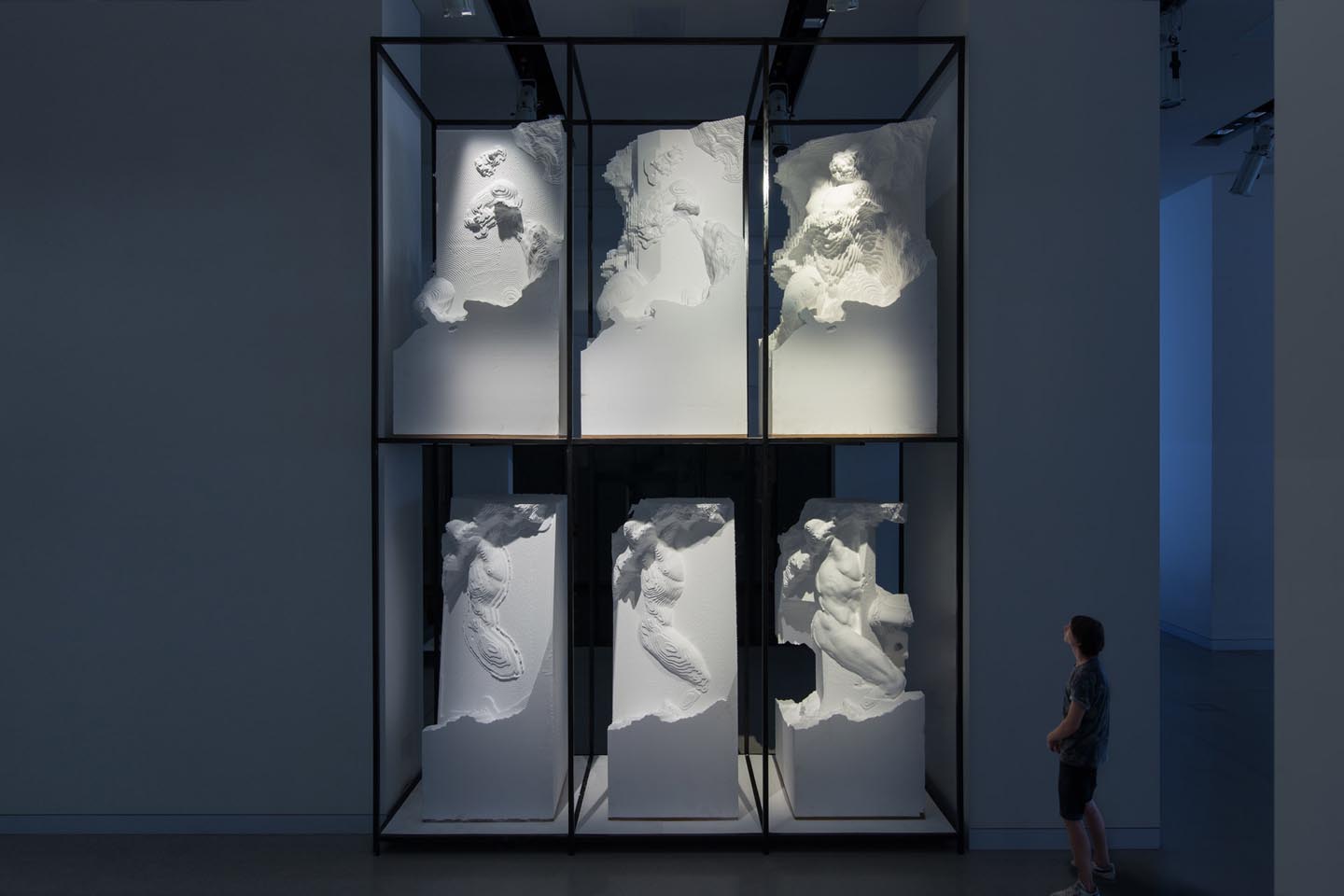
The most disturbing effect of Michelangelo’s already delicate balance is the absence of any form of teleology. It is ironic that Michelangelo’s entire reflection was based on it. Michelangelo eliminated excess and ecstasy, the feeling of stone and the dynamics of being appeared in the figures that emerged from the cold marble. Quayola’s chisel, on the other hand, is the computer algorithm. Its dynamics, although totally traceable to the artist’s action, present the post-human unknown. The “active principle that sets the totality of becoming in motion” gets stuck in the binary code, stumbling over it – the chisel from an extension of the hand becomes an extension of the brain and from an extension of the brain develops into an extension of thought. In the same way, the binary code goes from an extension of the hand and then becomes an extension of the hardware and, finally, results in an extension of the sum of thoughts involved – human and artificial.
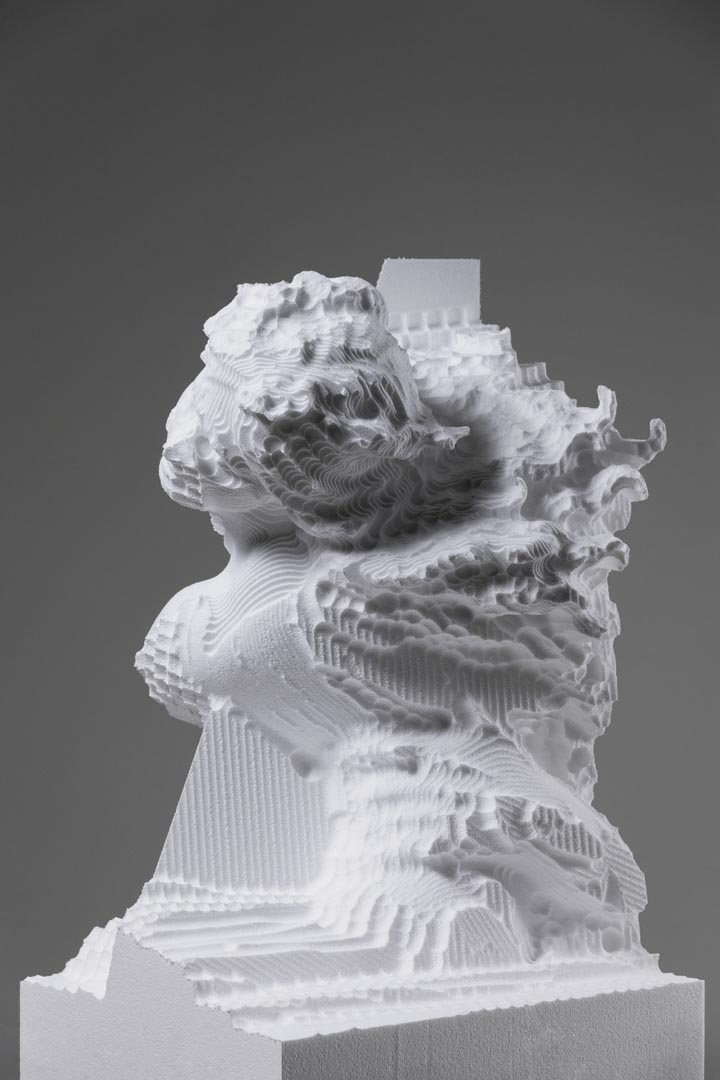
The feeling of stone is filtered by a God who, from pure light, has become pure electricity. If we compare Prisoners with Quayola’s Unfinished Sculptures, we note the natural and inevitable decay of a cultic aura in the latter works. However, this has been replaced by an essential aggressiveness, a contemporary zeitgeist, which puts the analogue and digital worlds into contact with each other through the pixellation of the sculpture, a three-dimensional spatial glitch. The other-than-self, distinct and concrete, to which Prisoners is linked, that extreme and cathartic faith that moved the rasp in Michelangelo’s hands, collapses into the rhizomatic and metamorphic contemporary reality, which in the space-time fluidity immerses the analogue and digital into an integrated Whole.

At the same time, however, we also notice an incredible similarity between these works of art, so distant in time and yet so close. In a way, Quayola’s perception is the same as Michelangelo’s. Michelangelo, as Delacroix argued, has a pictorial conception of sculpture. He does not work on internal mass but marks an outline which he fills by removing stone; he works within an oxymoron and part of his genius lies precisely in this atypical process. Only by focusing on the space around the image in this way, in open antithesis to the tuttotondo technique (full-relief), does he succeed in trapping the movement of Prisoners in stone, giving the material not only a formal but also a conceptual quality. Interestingly, in an interview about his Unfinished sculptures, Quayola himself said: “I focused on the space around these sculptures, not on the figures themselves.” Quayola’s pictorial sense can be found in all his works. It clearly manifests itself in many of his static or moving two-dimensional works, which are strictly digital, but it is also present in his non finito pieces which, through his particular sensitivity, manage to forge a connection with the Renaissance genius. The image of classical sculpture at the basis of Unfinished Sculptures is nothing more than a simulacrum emptied of character but not of pathos. So, in its computerised, algorithmic, artificial and post-human translation, where the artist acts as director of the whole process, the movement trapped in the stone acquires an existential nuance in a pattern that tends towards abstraction, losing its specific morphological character.
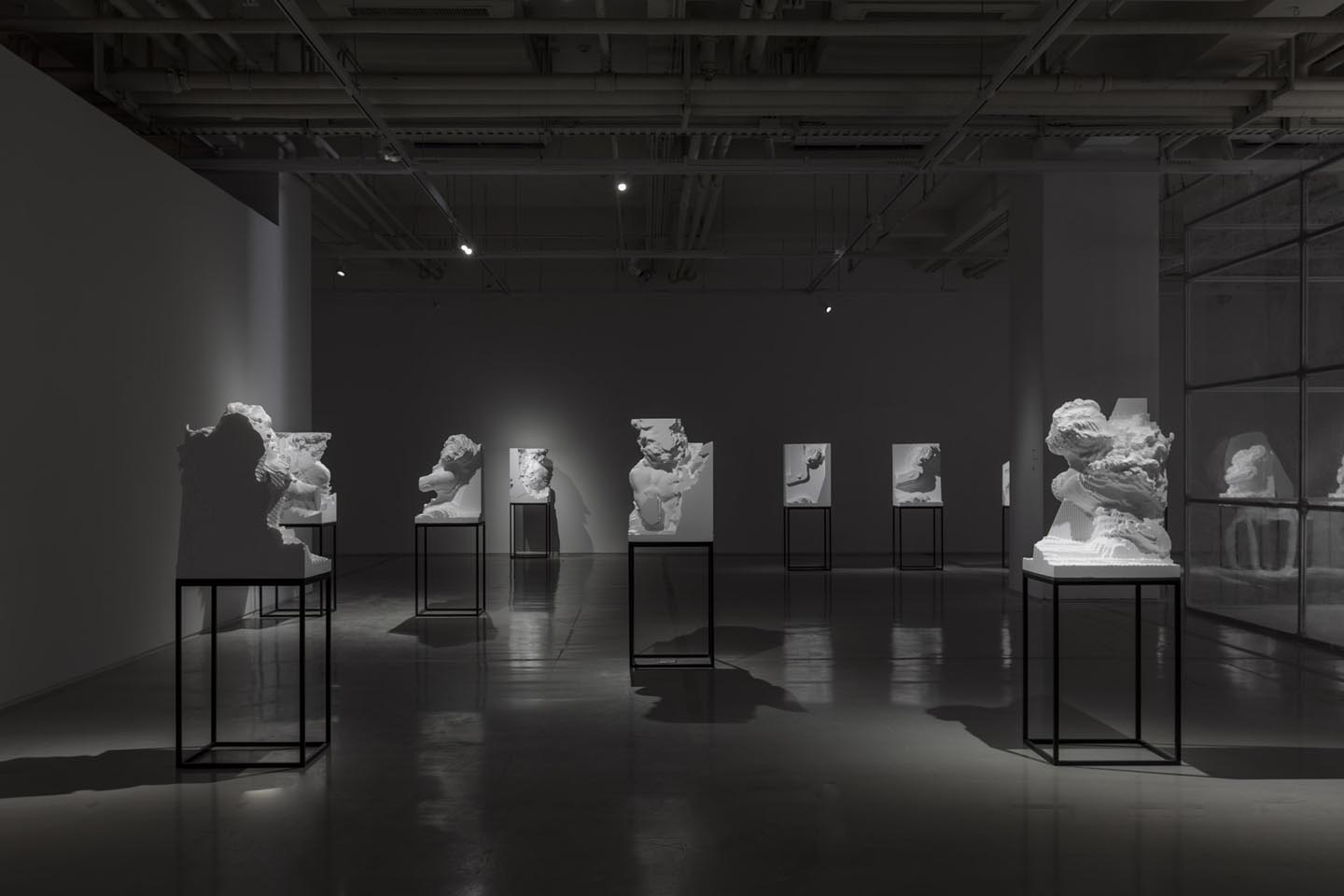
The representation of the statue changes with the medium – “the medium is the message” – so the prisoners or, in the Rondanini Pietà, Christ and the Madonna, are transformed into classical statues, which have been translated and then translated over and over. The essence of digital fluidity trapped in stone. The frustration of Prisoners, so elevated and all-encompassing, becomes astonishingly fragmented and stripped down, representing our frustration.

This reflection on sculptures that are so chronologically distant from each other, and yet conceptually related, is in no way intended to connect the two artists, except for the way in which they both masterfully manage to analyse the spirit of their times, producing the fascinating sparks that are their works of art. What is particularly interesting, however, is how the overwhelming changes over time, how the static rough stone that in the 16th century trapped the souls sculpted by Michelangelo, in the 21st century is moulded, in Quayola’s works, baroquely and mechanically, into a paralysing illusion. One is left feeling astonished and fascinated, teetering between being and appearing, a monumental emblem of a crisis – literally, therefore, one of evaluation, reflection and discernment – not religious like Michelangelo’s masterpieces, but so random and linked to the different planes of existence as to sink into the mysticism of contemporary reality.

QUAYOLA

images (all) Quayola, «Unfinished Sculptures», series, 2014 – ongoing


Tags: AIalgorithmalgoritmiarsarshakeFabio Giagnacovointelligenza artificialeMichelangeloQuayolascultpturescultura
ShareTweetShareSend
Previous Post

FRAME > IMAGINE PEACE

Next Post

Contact Zones at AOC F58 in Rome

Fabio Giagnacovo

Fabio Giagnacovo

Related Posts

A Body Engineered by Water – In Dialogue with Claudia Amatruda 
Focus

A Body Engineered by Water – In Dialogue with Claudia Amatruda 

by Arshake
03/02/2026
Daniele Puppi. Ehi Lampu in Rome
exhibitions

Daniele Puppi. Ehi Lampu in Rome

by Elena Giulia Rossi
02/12/2025

CALLS

Bill Fontana in San Peter’s Basilica
Calls

MA in History and Critical Thinking (HCT)

11/11/2025
Open call: Agora, a Gathering of Art and Philosophy
Calls

Open call: Agora, a Gathering of Art and Philosophy

28/10/2025
Dialogues across the Seas 2018-2025
Calls

Dialogues across the Seas 2018-2025

05/09/2025
Open Call. ALTERLIFE 25
Calls

Open Call. ALTERLIFE 25

30/07/2025
https://www.arshake.com/special-project-banner/young-italian-artists/
Facebook Twitter Instagram

Arshake is a collaborative artistic project, blurring the borders between art, science and technology, information and production.

  • Focus
  • Video post
  • Frame
  • Special Project
  • Interview
  • Calls
  • Exhibitions

One more step - Check your email and click the confirmation link

© 2024 – ARSHAKE

Welcome Back!

Login to your account below

Forgotten Password?

Retrieve your password

Please enter your username or email address to reset your password.

Log In
Gestisci Consenso Cookie
Per fornire le migliori esperienze, utilizziamo tecnologie come i cookie per memorizzare e/o accedere alle informazioni del dispositivo. Il consenso a queste tecnologie ci permetterà di elaborare dati come il comportamento di navigazione o ID unici su questo sito. Non acconsentire o ritirare il consenso può influire negativamente su alcune caratteristiche e funzioni.
Funzionale Always active
L'archiviazione tecnica o l'accesso sono strettamente necessari al fine legittimo di consentire l'uso di un servizio specifico esplicitamente richiesto dall'abbonato o dall'utente, o al solo scopo di effettuare la trasmissione di una comunicazione su una rete di comunicazione elettronica.
Preferenze
L'archiviazione tecnica o l'accesso sono necessari per lo scopo legittimo di memorizzare le preferenze che non sono richieste dall'abbonato o dall'utente.
Statistiche
L'archiviazione tecnica o l'accesso che viene utilizzato esclusivamente per scopi statistici. L'archiviazione tecnica o l'accesso che viene utilizzato esclusivamente per scopi statistici anonimi. Senza un mandato di comparizione, una conformità volontaria da parte del vostro Fornitore di Servizi Internet, o ulteriori registrazioni da parte di terzi, le informazioni memorizzate o recuperate per questo scopo da sole non possono di solito essere utilizzate per l'identificazione.
Marketing
L'archiviazione tecnica o l'accesso sono necessari per creare profili di utenti per inviare pubblicità, o per tracciare l'utente su un sito web o su diversi siti web per scopi di marketing simili.
  • Manage options
  • Manage services
  • Manage {vendor_count} vendors
  • Read more about these purposes
Visualizza le preferenze
  • {title}
  • {title}
  • {title}
No Result
View All Result
  • ABOUT US
    • ABOUT US
    • PROJECT
    • MEDIA/PARTNERSHIPS
    • CONTACT US
  • FOCUS
  • FRAME
  • VIDEO POST
  • SPECIAL PROJECT
    • ARSHAKE’S BANNER
    • CRITICAL GROUNDS
    • YOUNG ITALIAN ARTISTS
    • GAME OVER
    • GAME OVER • Loading
    • EXTERNAL PROJECTS
      • BACKSTAGE | ONSTAGE
      • PERCORSI • 6 years of the Terna Prize
      • TEMPO IMPERFETTO
  • RESOURCES
    • ARCHIVE
    • CALLS
    • ONLINE RESOUCES

© 2024 – ARSHAKE

This website uses cookies. By continuing to use this website you are giving consent to cookies being used. Visit our Privacy and Cookie Policy.