




To mark the forthcoming publication of the book, published by Kappabit and drawing on the exhibition series of the same name, Sottoforma, which aims to prompt reflection on the invisible as a form of knowledge, through a text by the curator of Sottoforma, Donatella Giordano, and contributions from the collector and art historian Giuseppe Garrera, the philosopher and contemporary art theorist Nicolas Martino, the physicist and university lecturer Giovanni Organtini, the curator and art critic Benedetta Carpi De Resmini, and the literary critic and literary historian Andrea Cortellessa – all of whom were previously featured during the public programme that ran alongside the entire exhibition cycle – a retrospective analysis is presented, with critical and analytical aims, of the central exhibition event featuring the artists Iginio De Luca and Liliana Moro at the Necci Hypogeum.

We may begin a brief retrospective analysis of the central exhibition event of the Sottoforma cycle, starting from the Nietzschean awareness of living fully – with its parallel implication of knowing how to die at the right moment – thereby dispelling the notion of the end of life as a curse upon the earth, fostering an acceptance of it in all its tragedy and thus bringing about a fulfilment of death and one’s own destiny. A free spirit emerges, dissenting from the herd mentality of the European masses and from the dogmas of ‘good’ and ‘evil’, which are the products of a pre-established traditional morality. Furthermore, the erosion of one’s critical faculties becomes apparent when evil—understood as a horror that undermines the organic nature of life—is generated by the individual who delegates their actions to imposed rules, ceasing to analyse them ethically and thus giving rise to Arendt’s concept of the ‘banality of evil’.
Conversely, consciousness and free will, as fundamental fields of information that do not exist in space-time, drive the interpretation of what is happening or has happened in the various forms of experience, and the hypothesis of invisible realities, the existence of which tends to explain the meaning and foundation of what occurs within experience.

Art plays a pivotal role in making profound truths, sensations and the uncertainty of the soul perceptible, by deconstructing the automatic habits of constantly focusing on the tangible. Since the 5th–4th centuries BC, the hypogeum has presented itself as a suitable place for setting aside the visible everyday world and immersing oneself in a reality—that of Eikasia—on the path towards Noesis, that activity of ‘noetic thought’, direct knowledge which is distinct from discursive reasoning, often prey to sophistical rhetoric and populism. In the contemporary era, this specific activity borders on nihilism as a further point for reflection. Consequently, the venue chosen by the curators Donatella Giordano and Agathe Jaubourg is particularly fitting: an underground space dating back to the 1st century BC, situated beneath the historic Necci bar, which offers an opportunity to reflect on what has been said so far, in relation to the cultural memory linked to its historical stratification, of which it preserves some material traces. Originally, the underground chamber was a pozzolana quarry; in the 19th century it was used as a wine cellar; whilst during the Second World War it was converted into an air-raid shelter. It was then rediscovered in July 2020 beneath the premises of the bar founded by the Necci family in 1924, when it was already a neighbourhood meeting place during the post-war reconstruction period. Necci was also a place frequented assiduously by the man for whom the profound spiritual forces—which elude modern pragmatism—can be summed up in the word ‘invisible’. In his writings and films, Pasolini denounced the disappearance of the ‘sacred’ and of peasant cultures, replaced by an anthropological transformation as invisible as it is devastating, brought about by consumerism. Necci was the setting for many scenes in his film *Accattone*. Today, the hypogeum has resumed its function as a cellar for fine wines, a venue for haute cuisine, and a space for hosting major events and art exhibitions. It is, however, its former role as an air-raid shelter and a space for the abandonment of pre-determined forms that forms the basis of the central exhibition of the three events in Sottoforma, which has hosted works by the artists Iginio De Luca and Liliana Moro.

In De Luca’s work, metaphysical answers are set aside to reveal the void of meaning and passive nihilism, explored through the phrase silently conveyed in Morse code via the pulsating light on the reddish tuff walls of a three-metre-high shaft. The passage is taken from Friedrich Nietzsche’s aphorism 146, ‘Beyond Good and Evil’, which reads: “Those who fight monsters must take care not to become monsters themselves in the process. And if you gaze long into the abyss, the abyss will also gaze into you”, transforming the well itself into an imaginative and evocative metaphor for the abyss, and indeed a parable of the state of our contemporary existence.
It is by no means far-fetched, at this point, to revisit the sensations evoked by *White Noise*, the novel by the American writer Don DeLillo (1985) and subsequently adapted into a film (2022) directed by Noah Baumbach. The abyss itself seems to engulf the life of the protagonist, Jack Gladney, a university lecturer who became renowned for being the first to undertake studies on the figure of Adolf Hitler. In the second part of the story, a chemical spill from a railway carriage causes a toxic cloud to form in the area where Jack lives with his family, forcing them to evacuate immediately. It is at this moment that the protagonist, worried about his exposure to the toxin, fears he might die, transforming the entire plot into a reflection on the fear of death. Following this interpretation, we can say that the artist Liliana Moro has drawn upon a powerful image of the abyss as a reference for her eponymous work, creating a close and reciprocal link with De Luca’s work. Jack, in fact, whilst intently examining the life of the former Chancellor of the German Reich, has become a victim of the black dust of death. Moro’s sound piece ‘Rumore bianco’, lasting 30’21’’, created during the pandemic and previously presented to the Art Fiera Bologna Commission in 2022, condenses everyday sounds and noises, alternating between the solitary sound of a departing aeroplane and the fanfare of a news programme’s theme tune. However, in certain sections of the track, sounds and noises give way to a breath of wind, to the whisper of white noise – a fictitious moment of stillness that conceals the prevailing state of uncertainty. In Sottoforma, through its refined dialogue, it becomes clear that our consciousness is the only means capable of bringing about an elevation of individual awareness.
“Sottoforma”, curated by Donatella Giordano and Agathe Jaubourg, featuring Iginio De Luca and Liliana Moro, 9–30 April 2026, part of a project comprising three consecutive exhibitions, of which the De Luca and Moro exhibition was preceded by Eva Marisaldi / Enrico Serotti and Luca Vitone (12–31 March) and followed by José Angelino and Elena Bellantoni (12–14 May 2026)
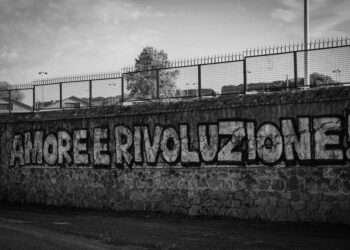
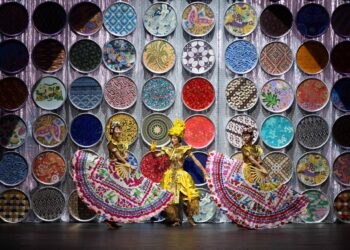
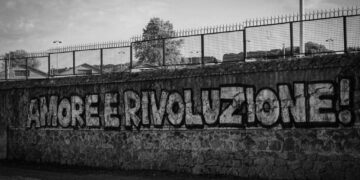
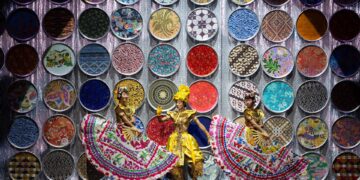
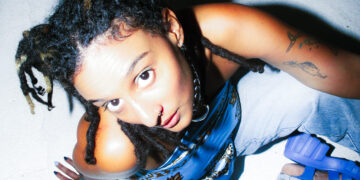
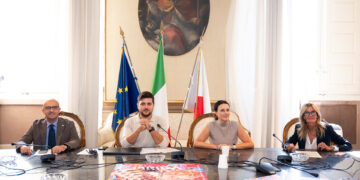
images: (cover 1-2-4) Sottoforma, curated by Donatella Giordano and Agathe Jaubourg, Ipogeo Necci, photo: Giovanni De Angelis (3) Iginio De Luca, Sottoforma, Ipogeo Necci, photo: Luis Do Rosario